
STARS: Major | All | Constellations | Chinese | About
Gomeisa is at 22°12′ Cancer with an orb of 1°00′
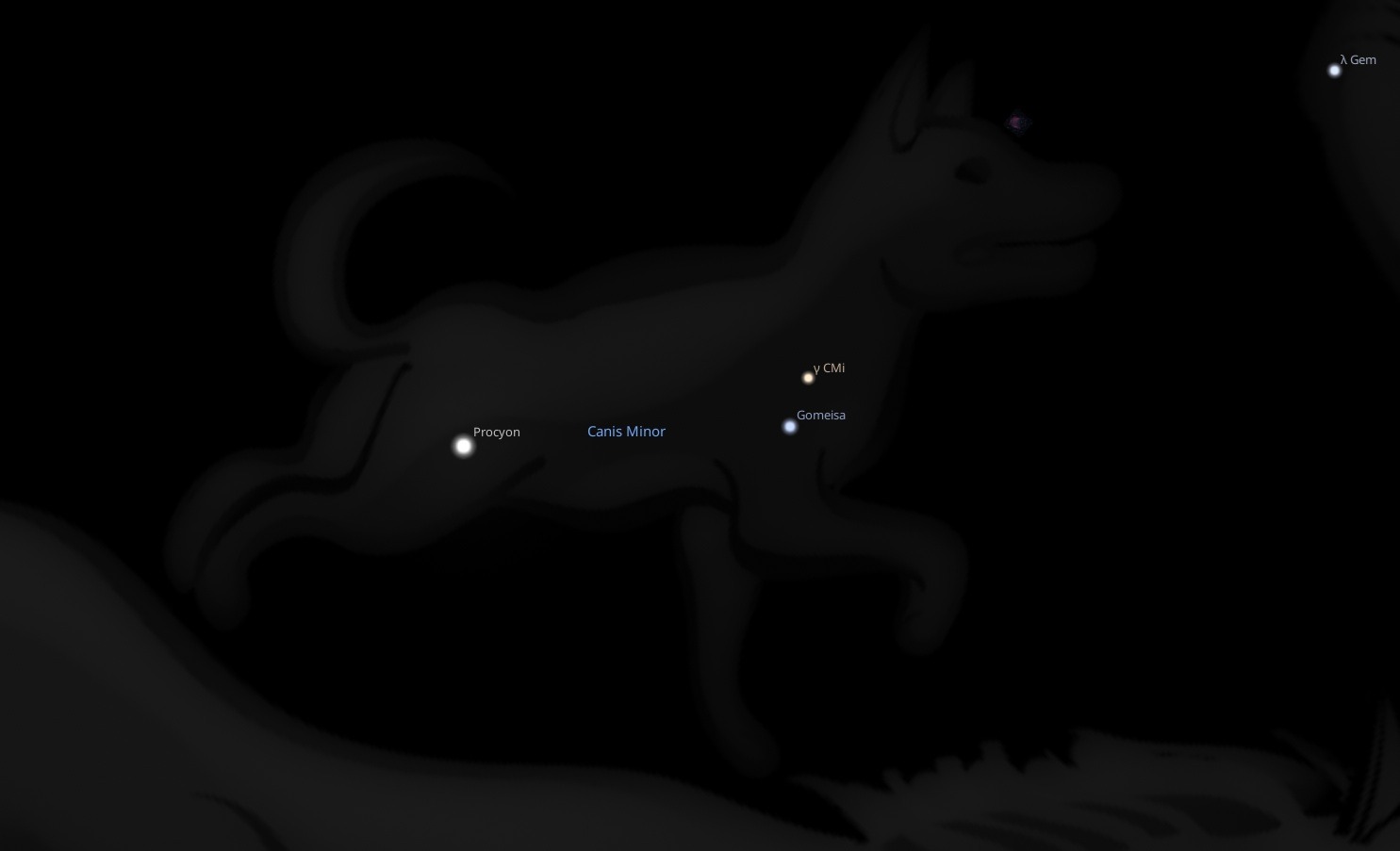
Canis Minor Constellation [Stellarium]
The traditional name Gomeisa, comes from the Arabic al-ghumaisa’ “the bleary-eyed (woman)” [1] short for مرزم الغميصاء mirzam al-ghumaisa’ “girdle of the bleary-eyed one“. In Arabic, the short form would be identical with the name of Procyon. In Chinese, it is known as 南河二 (Nán Hé èr, English: the Second Star of South River.)[2]
Occasionally it has been Al Gamus, from another of the Arabians’ titles for the whole; and Al Mursin, identical with the name of Beta Canis Major, and for a similar reason, – as if announcing the rising of the brightest star of the figure. [3]
Asterism Nanhe, the South River
21♋40 to 25♋47
The three stars of Nan He (the Southern River) and Bei He (the Northern River) flank Jing (the Eastern Well); it is also called the Celestial Gate and oversees bridges and passes. The Southern River is also called the Southern Garrison, the Southern Palace, the Yang Gate, the Yue Gate, and the Power Star. It governs fire-related matters. Between the two River Garrisons lies the constant path of the Sun, Moon, and five planets.
If the stars in Nan He appear unstable or shift, military conflict arises within China. If the river stars are incomplete or missing, then roads and passages become blocked, and floodwaters overflow.
If the Moon enters or exits between Nan He and Bei He along the central path, people will be at peace, the year will be prosperous, and there will be no warfare; if it moves south of this central path, the ruler will dislike it, and high-ranking ministers will not remain loyal.
If these stars appear bright and clear, it is a sign of good fortune; if they are dim or unstable in position, then border military conflicts arise, distant people rebel, and the ruler feels worried.
If the Moon transgresses Nan He, it signifies worry for the central kingdom; some sources say this indicates warfare, mourning events, droughts, or epidemics. If the Moon moves southwest, there will be military conflicts and droughts; if it enters Nan He, an epidemic among the people follows.
If a halo appears around the moon, earthworks projects are initiated. If the Moon with a halo passes over Nan He, warfare erupts in all directions. If it travels south of Nan Shu, then punishments and legal decrees become unjust or misapplied.
If Jupiter transgresses Nan He (South River), the northern regions face worry.
If Mars transgresses Nan He or Bei He, military conflict follows. If it lingers for more than thirty days in this region, rivers overflow; if it stays over Nan He (South River), crops fail to mature, and the queen consort will worry; if it guards the west of Nan He, fruit will not be harvested; if it is in the east, there will be attacks and wars.
If Saturn passes over Nan He (South River), drought follows, and the people worry; if it lingers there, warfare arises, and roads become impassable.
If Venus remains in this region for thirty days, rivers overflow; some sources say it indicates the presence of treacherous plots. If Venus guards both Nan He and Bei He (the two rivers), military conflict arises.
If a guest star resides in or lingers near this region, droughts and epidemics follow.
If a comet or brilliant meteor appears in this area, warfare follows; if it remains there for an extended time, drought occurs.
If meteors appear in this region, they signify war and mourning events, with worries arising at border garrisons or frontier posts. If a meteor passes between the two rivers, there will be calamity throughout the land.
If pale blue or white clouds intrude into this region, river passages become impassable; if they emerge and appear red, the emperor’s forces will march against feudal lords. If yellow-colored clouds enter, virtuous decrees or edicts are issued; if they emerge from it, disaster follows.
Song History, Volume 51, Chapter 4, 1346.
Constellation Canis Minor, the Lesser Dog
16♋37 to 05♌13
CANIS MINOR. The Lesser Dog.
Legend. Canis Minor represents Mæra, the hound of Icarius, who drowned himself on account of his grief at the death of his master (see BOÖTES). According to another account it was Helen’s dog who was lost in the Euripus.
Influence. Ptolemy gives no information as to the influence of the constellation itself, but merely describes that of its chief star, Procyon. By other authors, however, it is said to cause frivolity and either love of dogs or danger of dog-bites. It is noteworthy that the ideas of water and drowning seem to be universally associated with this constellation. In addition to the Greek ideas embodied in the legends its Euphratean name was the Water Dog, and its Chinese equivalent Nan Ho, the Southern River, certain of the stars being called Shwuy Wei, a Place of Water. Together with Canis Major this constellation is associated by the Kabalists with the Hebrew letter Tzaddi and the 18th Tarot Trump “The Moon”. [1]
The small constellation of Canis Minor (CMi) is identified chiefly with its major star, Procyon. Both the constellation and its major star portend wealth, fame, and good fortune. [3]
References
- http://stars.astro.illinois.edu/sow/gomeisa.html
- http://www.lcsd.gov.hk/CE/Museum/Space/Research/StarName/c_research_chinengstars_e_g.htm
- Star Names, Their Lore and Meaning, Richard Hinckley Allen, 1889, p.135.
- Fixed Stars and Constellations in Astrology, Vivian E. Robson, 1923, p.35.
- Manilius, Astronomica, 1st century AD, book 5, 317.[wp_ad_camp_3]