
STARS: Major | All | Constellations | Chinese | About
00♍44 to 15♏32
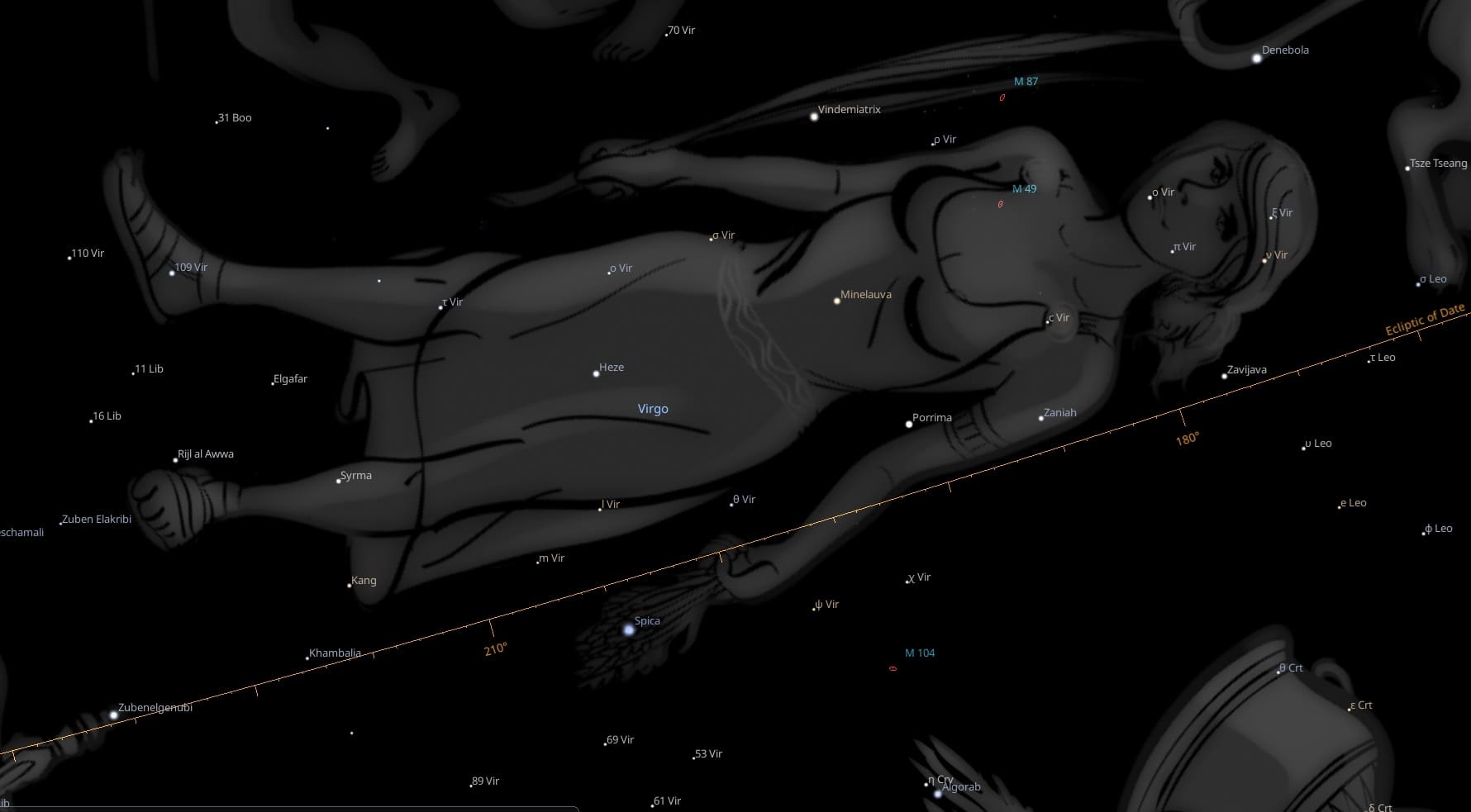
Virgo Constellation [Stellarium]
Constellation Virgo the Maiden is one of the 12 ecliptic constellations and lies between Leo and Libra. It also borders Serpents Caupt, Boötes, Coma Berenices, Crater, Corvus, Hydra and the obsolete constellations Mons Maenalus.
Virgo is one of the 48 constellations listed by Ptolemy in the 2nd century and remains one of the 88 modern constellations. It spans over 50 degrees of the zodiac in the Signs of Virgo, Libra and Scorpio.
Abbreviation: Vir
Genitive: Virginis
Virgo Constellation Stars
| 2000 | 2050 | Star | Name | Sp. Class | Mag. | Orb |
|---|---|---|---|---|---|---|
| 23♍20 | 24♍02 | ξ Vir | Nèipíngyī | A4 | 4.84 | 1°00′ |
| 24♍10 | 24♍52 | ν Vir | Nèipíngèr | M0 | 4.04 | 1°20′ |
| 27♍11 | 27♍53 | β Vir | Zavijava | F8 | 3.59 | 1°40′ |
| 27♍34 | 28♍16 | π Vir | Nèipíngsān | A5 | 4.65 | 1°00′ |
| 27♍42 | 28♍24 | ο Vir | Nèipíngsì | G8 | 4.12 | 1°20′ |
| 02♎04 | 02♎24 | M87 | M87 Virgo A | 8.60 | 1°00′ | |
| 03♎21 | 04♎03 | c Vir | Yèzhě | K1 | 4.97 | 1°00′ |
| 04♎50 | 05♎32 | η Vir | Zaniah | A2 | 3.89 | 1°30′ |
| 05♎31 | 06♎13 | ρ Vir | Jiǔqīngyī | A0 | 4.88 | 1°00′ |
| 09♎56 | 10♎38 | ε Vir | Vindemiatrix | G8 | 2.85 | 2°00′ |
| 10♎08 | 10♎50 | γ Vir | Porrima | F0 | 2.74 | 2°00′ |
| 11♎27 | 12♎09 | δ Vir | Minelauva | M3 | 3.39 | 1°40′ |
| 15♎12 | 15♎55 | k Vir | Xìngchén | A3 | 5.79 | 1°00′ |
| 15♎47 | 16♎29 | σ Vir | Tiāntiányī | M2 | 4.78 | 1°00′ |
| 16♎24 | 17♎06 | 71 Vir | K0 | 5.65 | 1°00′ | |
| 18♎14 | 18♎56 | θ Vir | Apami-Atsa | A1 | 4.38 | 1°20′ |
| 22♎08 | 22♎50 | ζ Vir | Heze | A3 | 3.38 | 1°40′ |
| 22♎47 | 23♎29 | 53 Vir | Tianmenyi | F6 | 5.04 | 1°00′ |
| 23♎35 | 24♎17 | l Vir | Apamvatsa | M3 | 4.68 | 1°00′ |
| 23♎50 | 24♎33 | α Vir | Spica | B1 | 0.97 | 2°40′ |
| 26♎08 | 26♎51 | 69 Vir | Tianmener | K1 | 4.76 | 1°00′ |
| 27♎45 | 28♎27 | τ Vir | Tiāntiánèr | A3 | 4.23 | 1°20′ |
| 03♏48 | 04♏30 | ι Vir | Syrma | F7 | 4.07 | 1°20′ |
| 04♏29 | 05♏12 | κ Vir | Kang | K3 | 4.18 | 1°20′ |
| 05♏27 | 06♏09 | φ Vir | Elgafar | G2 | 4.81 | 1°00′ |
| 06♏57 | 07♏39 | λ Vir | Khambalia | A1 | 4.52 | 1°20′ |
| 08♏31 | 09♏13 | 109 Vir | A0 | 3.73 | 1°30′ | |
| 10♏08 | 12♏50 | μ Vir | Rigilawwa | F2 | 3.87 | 1°30′ |
| 12♏37 | 13♏20 | 110 Vir | K0 | 4.39 | 1°20′ |
Virgo Star Names
71 Vir was part of the obsolete constellation Mons Maenelus.
α Vir is officially named Spica, meaning “the Ear of Grain.”
β Vir is officially named Zavijava, meaning “the Angle of al-ʿawwāʾ.”
γ Vir is officially named Porrima, after a Roman goddess of prophecy.
δ Vir is officially named Minelauva.
δ Vir bore the traditional, medieval names Auva and Minelauva from the Arabic من العواء min al-ʽawwāʼ, meaning “in the lunar mansion of ʽawwaʼ.” [1]
δ, 3.6, golden yellow, although individually unnamed in our lists, was one of the ʿAwwāʾ. The stars β, η, γ, δ, and ε Vir outline the Kennel of the Arab Dogs. It formed the 11th manzil, Al ʿAwwāʾ, “the Barker,” which was considered of good omen.
On the Euphrates, δ Vir was Lu Lim, “the Gazelle, Goat, or Stag,” — or perhaps “King;” and, with ε, probably Mas-tab-ba, another of the seven pairs of Twin-stars of that country. The Hindus called it Āpa, or Āpas, “the Waters,” (see also ζ Vir) and the Chinese, Tsze Seang, “the Second Minister of State.”
Secchi alluded to δ as bellissima, from its most beautiful banded spectrum of the 3d class of spectra, like that of α Herculis. [2]
δ Vir belongs to the Chinese asterism Tàiwēizuǒyuán, “Left Wall.” It has the traditional names Tàiwēizuǒyuánsān, “3rd star of Left Wall,” Dōngcìxiàng, “The Second Eastern Minister,” and Zhōnghuádōngmén, “Middle gate in the east.” [3]
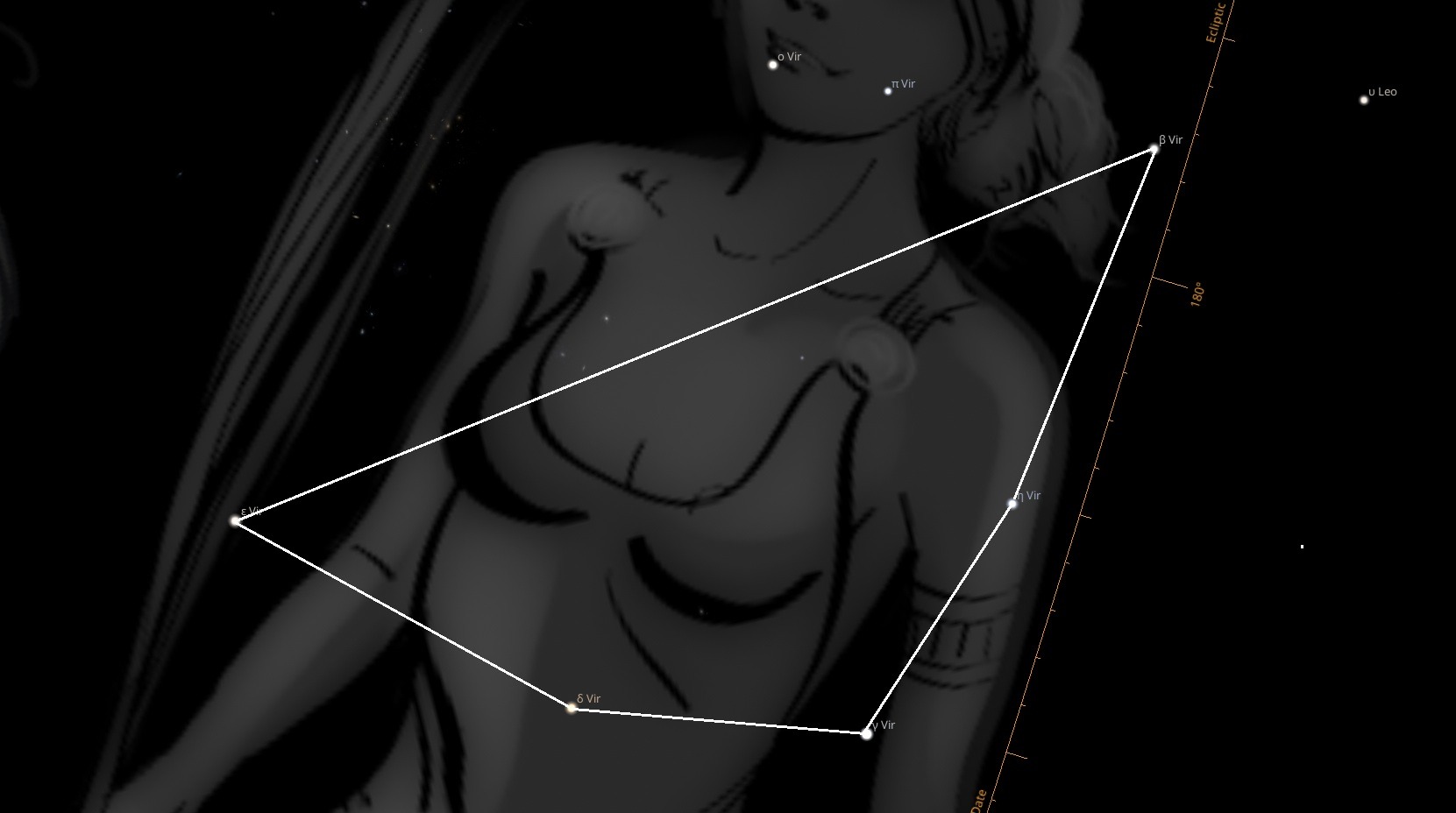
11th Arabic Manzil, Al ʿAwwāʾ
ε Vir is officially named Vindemiatrix, meaning “the Grape Gatherer.”
ζ Vir is officially named Heze, of unknown origin.
ζ Vir is listed in the Indian Sūrya Siddhānta as Āpa, meaning “Water.” [4] (see also θ and l (74) Vir)
ζ Vir belongs to the Chinese asterism Jiǎo, “Horn,” and has the traditional name Jiǎosuèr, “2nd star of Horn.” [3]
η Vir is officially named Zaniah, meaning “the Angle of al-‘awwā’.”
θ Vir has the traditional name Apami-Atsa.
θ, Triple, 4.4, 9, and 10, pale white, violet, and dusky. Moderns have no name for it, but in the Sūrya Siddhānta it was Apami-Atsa, “the Child of the Waters.” [2] (see also ζ and l (74) Vir)
θ Vir belongs to the Chinese asterism Píngdào, “Flat Road,” and has the traditional name Píngdàoyī, “1st star of Flat Road.” [3]
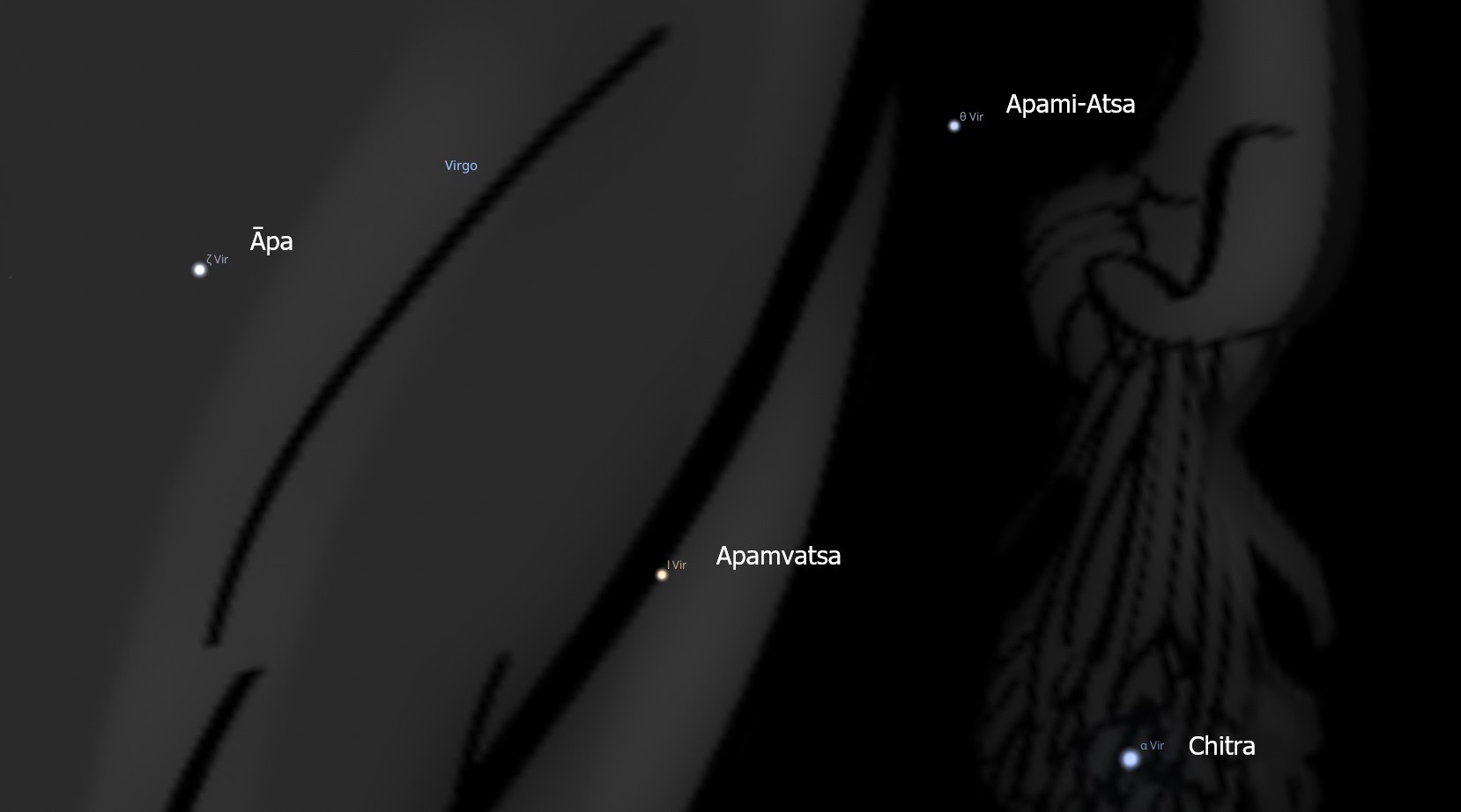
Sanskrit Star Names
ι Vir is officially named Syrma, meaning “train of a dress.”
κ Vir is officially named Kang.
κ Vir belongs to the Chinese asterism Kàng, “Neck,” and has the traditional name Kàngsuyī, “1st star of Neck.” [3]
The stars ι, κ, and φ Vir were the Arabian ḣimār, “skirt,” of the garment. They formed the 13th manzil, Al Ghafr, “the Covering.” Al Bīrūnī also said that the Arabs considered this the most fortunate of their lunar stations, as lying between the evils of the Lion’s teeth and claws on one side and the tail and venom of the Scorpion on the other, adding that the horoscope of the Prophet lay here, and that the date of the birth of Moses coincided with it.
As a lunar station these stars were the Sogdian Sarwa and the Khorasmian Shushak, “the Leader;” the Persian Huçru, “the Good Goer;” and the Coptic Khambalia, “Crooked-clawed,” λ being substituted for φ; and it is said that they were the Akkadian Lu Lim, “the He Goat, Gazelle, or Stag,” the original perhaps also meaning “King,” and employed for δ. [2]
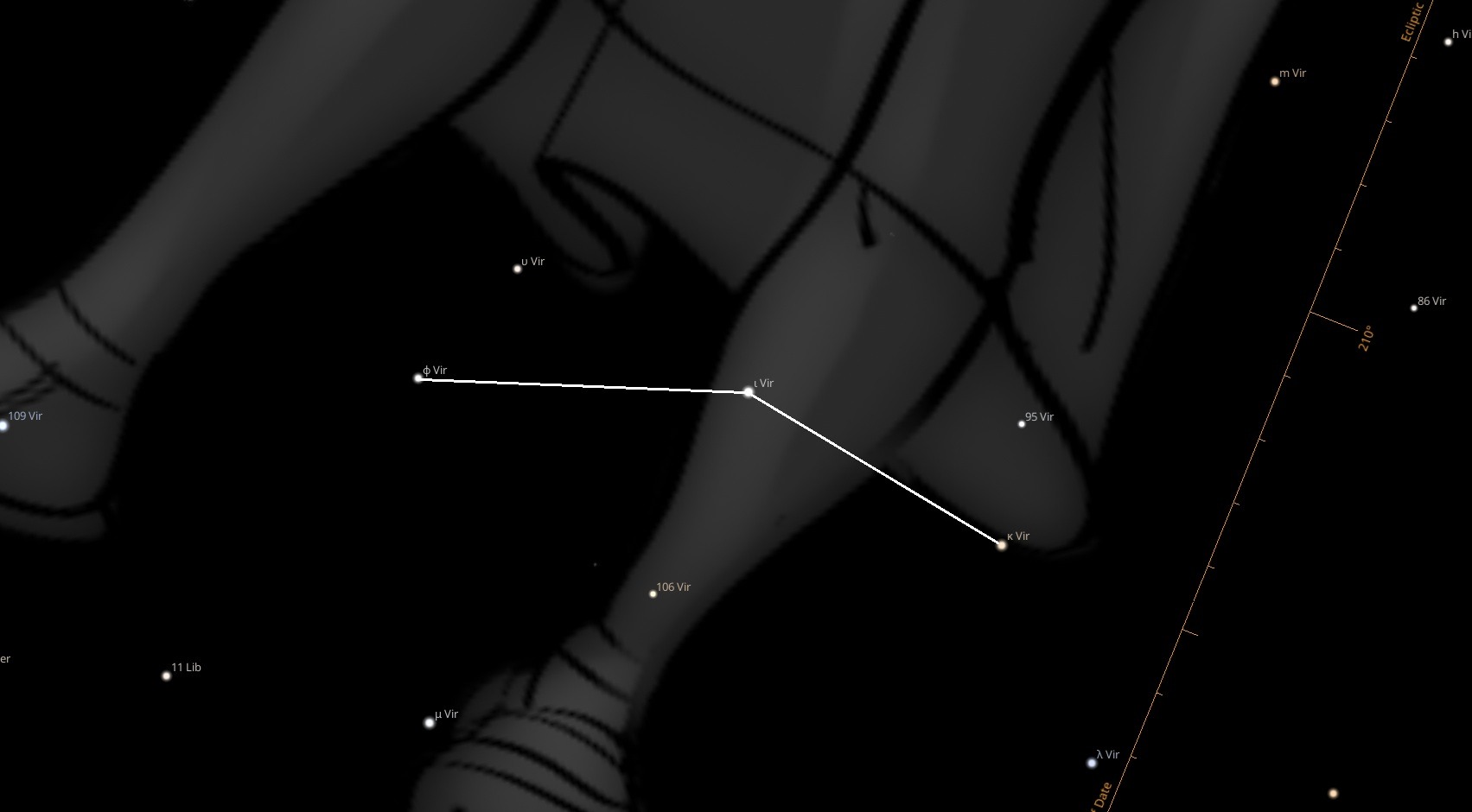
13th Arabic Manzil, Al Ghafr
λ Vir is officially named Khambalia, meaning “Crooked-clawed.”
μ Vir is formally named Rigilawwa. [5]
μ, a 3.9‑magnitude, was Al Achsasi’s Rijl al ʽAwwā᾽, “the Foot of the Barker.” It has been included with δ Librae in the Akkadian lunar asterism Mulu Izi, a title also applied to ε; the Sogdian Gasarwa, and the Khorasmian Sara-fsariwa, both signifying the “One next to the Leader” — i.e., next to the lunar asterism, ι, κ, and λ (Khambalia). [2]
ν Vir belongs to the Chinese asterism Nèipíng, “Inner Screen,” and has the traditional name Nèipíngèr, “2nd star of Inner Screen.” [3]
ξ Vir belongs to the Chinese asterism Nèipíng, “Inner Screen,” and has the traditional name Nèipíngyī, “1st star of Inner Screen.” [3]
ο Vir belongs to the Chinese asterism Nèipíng, “Inner Screen,” and has the traditional name Nèipíngsì, “4th star of Inner Screen.” [3]
π Vir belongs to the Chinese asterism Nèipíng, “Inner Screen,” and has the traditional name Nèipíngsān, “3rd star of Inner Screen.” [3]
ρ Vir belongs to the Chinese asterism Jiǔqīng, “Nine Senior Officers,” and has the traditional name Jiǔqīngyī, “1st star of Nine Senior Officers.” [3]
σ Vir belongs to the Chinese asterism Tiāntián, “Celestial Farmland,” and has the traditional name Tiāntiányī, “1st star of Celestial Farmland.” [3]
τ Vir belongs to the Chinese asterism Tiāntián, “Celestial Farmland,” and has the traditional name Tiāntiánèr, “2nd star of Celestial Farmland.” [3]
φ Vir is officially named Elgafar.
The stars ι, κ and φ Vir form a line on the Train of the Virgin’s robe. They were the Arabian ḣimār, “skirt,” of the garment. They formed the 13th manzil, Al Ghafr, “the Covering.” [2] (see κ Vir.)
φ Vir belongs to the Chinese asterism Kàng, “Neck,” and has the traditional name Kàngsusān, “3rd star of Neck.” [3]
16 (c) Vir belongs to the Chinese asterism Yèzhě, “Usher to the Court,” and is traditionally named Yèzhě. [3]
44 (k) Vir belongs to the Chinese asterism Jìnxián, “Recommending Virtuous Men,” and is traditionally named Xìngchén. [3]
53 Vir belongs to the Chinese asterism Tiānmén, “Celestial Gate,” and has the traditional name Tiānményī, “1st star of Celestial Gate.” [3]
69 Vir belongs to the Chinese asterism Tiānmén, “Celestial Gate,” and has the traditional name Tiānménèr, “2nd star of Celestial Gate.” [3]
71 Vir has no proper name. It belonged to the obsolete constellation Mons Maenelus.
74 (l) Vir is officially named Apamvatsa. Listed in the Indian Sūrya Siddhānta as Āpaṃvatsa, “calf of the waters.” [6] (see also ζ and θ Vir)
109 Vir has no proper name.
110 Vir has no proper name.
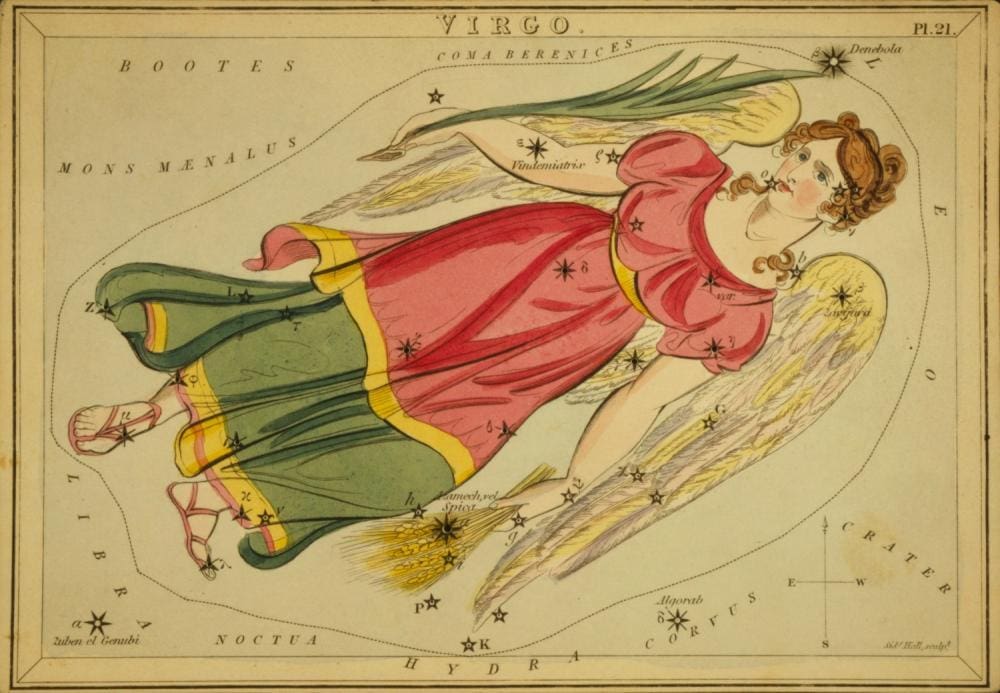
Virgo Constellation [Urania’s Mirror]
Virgo Constellation Astrology
Manilius (@ 35 AD)
But modest Virgo’s Rays give polisht parts,
And fill Mens Breasts with Honesty and Arts;
No tricks for Gain, nor love of Wealth dispense,
But piercing Thoughts, and winning Eloquence;
With words persuasive, and with Rhetorick strong
They rule, and are e’en Monarchs by their Tongue.
Through Nature’s Secrets too, they coldly press,
Tho’ deeply hid, and meet a just success.
In Short-Hand skill’d, where little Marks comprise,
Whole words, a Sentence in a Letter lies;
And whilst Obedient hands their Aid afford,
Prevent the Tongue and Fix the falling Word.
But bashful Modesty, casts down their Eyes,
The best of Vices, yet ’tis still a Vice,
Because it stifles, checks or nips like Frost,
A blooming Vertue, and the Fruit is lost.
Besides, though strange such Influence should come
From Virgo’s Rays, she gives a fruitful womb. [7]
The temperaments of those whose span of life she pronounces at their birth Erigone will direct to study, and she will train their minds in the learned arts. She will give not so much abundance of wealth as the impulse to investigate the causes and effects of things. On them she will confer a tongue which charms, the mastery of words, and that mental vision which can discern all things, however concealed they be by the mysterious workings of nature. From the Virgin will also come the stenographer: his letter represents a word, and by means of his symbols he can keep ahead of utterance and record in novel notation the long speech of a rapid speaker. But with the good there comes a flaw: bashfulness handicaps the early years of such persons, for the Maid, by holding back their great natural gifts, puts a bridle on their lips and restrains them by the curb of authority. And (small wonder in a virgin) her offspring is not fruitful. [8]
ASCENDING
When Virgo rises (who whilst Right Prevail’d
Rul’d here below, retreating when it fail’d),
To awful Honors all the Births must rise
Profoundly skill’d in Sacred Mysteries;
Good, Pious, Just, Devout, unus’d to Rage
And great Examples to the looser Age. [7]
At her rising Erigone, who reigned [Erigone, properly the daughter of Icarius, is here confused with Astraea, who is often (thought not elsewhere by Manilius) identified with Virgo] with justice over a bygone age and fled when it fell into sinful ways, bestows high eminence by bestowing supreme power; she will produce a man to direct the laws of the state and the sacred code, one who will tend with reverence the hallowed temples of the gods. [8]
Ptolemy (@150 AD)
Of the stars in Virgo, those in the head and the one upon the tip of the southern wing have an effect like that of Mercury and, in less degree, of Mars; the other bright stars of the wing and those on the girdles like that of Mercury and, in a measure, of Venus; the bright star in the northern wing, called Vindemiator, like those of Saturn and Mercury; the so‑called Spica, like that of Venus and, in a less degree, that of Mars; those in the tips of the feet and the train like that of Mercury and, in a less degree, Mars. [9]
Maternus (@335 AD)
I.16. Ascendant in Virgo. If the horoscope is found in Virgo, he will be involved in many labors and many worries, but to whom the divinity either through a dream or some divination, or certainly by answers and he preaches everything by lot. But he perpetuates his prayers to the divinity with a manifold continuation. ****** <a> incurring the allurements of morals with the passive desires of the eyes, and who desires the intercourse of all women with a projected desire. But he will suffer from these vices for as long as the anaphora of his sign has been completed. He will indeed be a happy human being, and with whom the pure bond of friendship remains, and to whom the concern for someone’s loss pertains, knowing much and searching for the secrets of all disciplines, retaining everything in the cloister of his chest, but adorned with the proclamation of simplicity, and to whom either the grace of learned speech or the office of business, or from succession or from sacred things or from virtue some great happiness and great substance of faculty is conferred.
17. If he is found in Gemini MC., he will give substance from public [or] sacred things, but this only when he has entered the threshold of old age. He will be a worshipper of religions and gods, just, and to whom the majority of citizens will strive to obey, searching for hidden things with constant research, knowledgeable in many arts and disciplines , and in the last period of his life, the duty of a complete and upright life is shown to many by him.
18. If he is set in Pisces, he will travel through many strange places, be known to many people, and many will be flattered by his diligent service. He will be grateful, happy, handsome, sharp, involved in many occupations, and always <fit> for every conversation and noble. If he is found in Sagittarius IMC. He will be happy and his relatives will give him wealth, and many will flatter him. He will be known to all, giving thanks to the gods for his happiness, or public sacred things will be entrusted to him. He will rejoice in the happiness of his children, and will alleviate the pain of his lost children by having received a happy offspring; he will be fit for everything, he will also be learned and will be seen for his good fortune in agility.
III.23. Saturn in Virgo. Whoever has Saturn in Virgo at birth will suffer from illnesses and inconveniences in life in their early years, but then they are involved in stronger evils when Saturn transits Capricorn or Taurus, or when double signs has entered. In these signs also he decrees troubles, losses, cares, pains and sudden dangers. But going through the other signs he decrees good acts, good occupations and the adornment of good happiness, so that from these acts they may obtain both increase and glory in their patrimony, or certainly, freed from inconveniences, labors and dangers, they may obtain rest. He will have a happy and glorious time.
24. But if Saturn comes [into Virgo or] to the sign of Virgo in the birth, he will be able to decree no happiness for them. Indeed, they will have more from their own strength than from the faculties of their parents, and they will be now humble, now exalted. They are transferred from places and from business by constant reasons, and whatever was first obtained by them is wasted by miserable and profuse lacerations, and when all the faculty of substance has been dissipated, they again obtain another faculty of substance; but they squander it again by the same reason, and they could never possess the patrimony they had acquired.
25. They will certainly always be unstable around women in their prime, but even women in their prime will be those who have been allotted wives by the laws, and will neither consent with them, nor will they derive any useful advantages from them. But neither will virgins be allotted wives, but they either marry women who have been raped by others, or those who have already borne children. But if virgins by any chance have been allotted wives, they are quickly separated from their company. But they will not have the knowledge of a single woman, they mix with the ignoble and abject, and they always love them faithfully.
26. They will be full of learning and wisdom, devoted to many pursuits, and desiring many things, <but> from whatever they have acquired, <and> they will squander the substance of their patrimony, and will suffer constant losses for others, and in these very things they will be deceiving with cunning falsehood. They will also be prepared and thrown into dangers, being placed in public places. They will be involved in popular studies, known to all and intimate to all. They will grieve over the misfortunes of their children, and will squander their patrimony, when <in> the juncture of procreation or when Saturn is found in necessary places. Some will also be allotted wives who are related to them. They will have vices and constant pains in necessary places of the body.
27. But if he himself is the lord of the times, dividing the times for himself and the other stars, they will be in cares, in injuries, and in wanderings, enduring inconveniences without the cause of wandering, and will be in such dangers that they will come to many dangers. For some will have dangers from high places or from precipices, or from beasts or from four-footed animals or from water, and so they will see the dangers of death placed before their eyes, that then they will think themselves reborn.
28. They will come to the sight of great and powerful men, and when they are sought by them, they are delivered by their help. And when they are delivered from all these dangers, they are lifted up by the joys of happiness. They will indeed be contentious, and who will never be able to endure the shame of modesty. They will be human long-lived, and to whom happiness confers itself slowly. But then it will shine if Saturn is not the lord of procreation.
IV.14. Jupiter in Virgo. Whoever has Jupiter in Virgo will be virtuous, well-bred, and chaste, efficient, faithful, always loving friends with good affection, of honest character, contentious, powerful, and industrious, not having one course in life, as long as Saturn has passed the diameter of the sign in which Saturn himself is placed in procreation. But when he is in Pisces, they will be in storms, in losses, in sickness, in sorrows, in cares.
15. But when Saturn has passed from Pisces, then glory, then power, then they are allotted chaste and benevolent wives, serving the interests of their husbands. They will have sorrows about their children, as long as the times of Saturn have been completed. They will be in great honor and in great powers, which powers are decreed for the substance of procreation. [10]
Allen (1889)
Virgo,
generally has been figured with the palm branch in her right hand and the spica, or ear of wheat, in her left. Thus she was known in the Attic dialect as Κόρη, “the Maiden,” representing Persephone, the Roman Proserpina, daughter of Demeter, the Roman Ceres
Virgo also was Erigone, — perhaps from the Homeric Ἐριγένεια, “the Early Born,” for the constellation is very old, — a stellar title appearing in Vergil’s apotheosis of his patron Augustus. This was the maiden who hung herself in grief at the death of her father Icarius, and was transported to the skies with Icarius as Boötes, and their faithful hound Maira as Procyon, or Sirius.
Sometimes she was figured with the Scales in her hands, whence she has been considered Δίκη, “the divinity of Justice,” the Roman Justa or Justitia; and Astraea, the starry daughter of Themis, the last of the celestials to leave the earth, with her modest sister Pudicitia, when the Brazen Age began.
Thus she is the oldest purely allegorical representation of innocence and virtue. This legend seems to be first found with Hesiod, and was given in full by Aratos, his longest constellational history in the Phainomena. Other authors mentioned her as Εἰρήνη, “Irene,” the sister of Astraea, and the Pax of the Romans, with olive branch; as Concordia; as Παρθένος Δίος, “the Virgin Goddess;” as Σίβυλλα, “the Singing Sibyl,” carrying a branch into Hades; and as Τύχη, the Roman Fortuna, because she is a headless constellation, the stars marking the head being very faint.
In Egypt Virgo was drawn on the zodiacs of Denderah and Thebes, much disproportioned and without wings, holding an object said to be a distaff marked by the stars of Coma Berenices; while Eratosthenes and Avienus identified her with Isis, “the thousand-named goddess,” with the wheat ears in her hand that she afterwards dropped to form the Milky Way, or clasping in her arms the young Horus, the infant Southern sun-god, the last of the divine kings. This very ancient figuring reappeared in the Middle Ages as the Virgin Mary with the child Jesus, Shakespeare alluding to it in Titus Andronicus as the
Good Boy in Virgo’s lap;
and Albertus Magnus, of our 13th century, asserted that the Saviour’s horoscope lay there. It has been said that her initials, MV, are the symbol for the sign, ♍; although the International Dictionary considers this a monogram of Παρ, the first syllable of Παρθένος, one of Virgo’s Greek titles; and others, a rude picturing of the wing of Istar, the divinity that the Semites assigned to its stars, and prominent in the Epic of Creation.
This Istar, or Ishtar, “the Queen of the Stars,” was the Ashtoreth of the 1st Book of the Kings, xi.5, 33, the original of the Aphrodite of Greece and the Venus of Rome; perhaps equivalent to Athyr, Athor, or Hathor of the Nile, and the Astarte of Syria, the last philologically akin to our Esther and Star, the Greek Ἀστήρ. Astarte, too, was identified by the Venerable Bede with the Saxon goddess of spring, Eostre, at whose festival, our Easter, the stars of Virgo shine so brightly in the eastern evening sky; and the Sumerians of southern Babylonia assigned this constellation to their sixth month as the Errand, or Message, of Istar.
In India Virgo was Kanya, the Tamil Kauni, or Maiden, — in Hyde’s transcription, Kannae, — mother of the great Krishna, figured as Goddess sitting before a fire, or as a Gūl; and in the Cingalese zodiac as a Woman in a Ship, with a stalk of wheat in her hand. Al Bīrūnī thought this ship marked by the line of stars β, η, γ, δ, and ε, like a ship’s keel. Varāha Mihira borrowed the Greek name, turning it into Parthena, Partina, or Pathona.
The early Arabs made from some members of the constellation the enormous Lion of their sky; and of others the Kennel Corner, with dogs barking at the Lion. Their later astronomers, however, adopted the Greek figure, and called it Al ʽAdhrā᾽al Naṭhīfah, “the Innocent Maiden,” remains of which are found in the mediaeval titles Eladari, Eleadari, Adrendesa, and in the Adrenedesa of Albumasar. But as they would not draw the human form, they showed the stars as a sheaf of wheat, Al Sunbulah, or as some stalks with the ripened ears of the same, from the Roman Spica, its brightest star. Kazwini gave both of these Arabian names, the last degenerating into Sunbala, found in Bayer, and Sumbela, still occasionally seen. The Almagest of 1515 says Virgo est Spica.
It appears as Ki, the 20th in the Euphratean cycle of ecliptic constellations, and considered equivalent to Asru, a Place, i.e. the moon station that Spica marked; but Jensen thinks that the original should be Siru“, or Shiru, perhaps meaning the “Ear of Corn;” much of this also is individually applied to Spica.
In astrology this constellation and Gemini were the House of Mercury, Macrobius saying that the planet was created here; the association being plainly shown by the caduceus of that god, the herald’s trumpet entwined with serpents, instead of the palm branch, often represented in her left hand. But usually, and far more appropriately, Virgo’s stars have been given over to the care of Ceres, her namesake, the long-time goddess of the harvest. For her astrological colors Virgo assumed black speckled with blue; and was thought of as governing the abdomen in the human body, and as bearing rule over Crete, Greece, Mesopotamia, Turkey, Jerusalem, Lyons, and Paris, but always as an unfortunate, sterile sign. Manilius asserted that in his day it ruled the fate of Arcadia, Caria, Ionia, Rhodes, and the Doric plains. Ampelius assigned to it the charge of the wind Argestes, that blew to the Romans from the west-southwest according to Vitruvius, or from the west-northwest according to Pliny.
The latter said that the appearance of a comet within its borders implied many grievous ills to the female portion of the population.
Virgo was associated with Leo and with the star Sirius in the ancient opinion that, when with the sun, they were a source of heat.
But all these figurings, ancient as some of them may be, are modern when compared with the still enduring Sphinx generally claimed as prehistoric, perhaps of the time of the Hor-she-shu, long anterior to the first historical Egyptian ruler, Menes; and constructed, according to Greek tradition, with Virgo’s head on Leo’s body, from the fact that the sun passed through these two constellations during the inundation of the Nile. Some Egyptologists, however, would upset this astronomical connection of the Virgin, Lion, and Sphinx, Mariette claiming the head to be that of the early god Harmachis, and others as of an early king.
Ptolemy extended the constellation somewhat farther to the east than we have it, the feet being carried into the modern Libra, and the stars that Hipparchos placed in the shoulder shifted to the side, to correct, as he said, the comparative distances of the stars and members of the body. Upon our maps it is about 52° in length, terminating on the east at λ and μ, and so is the longest of the zodiac figures. [2]
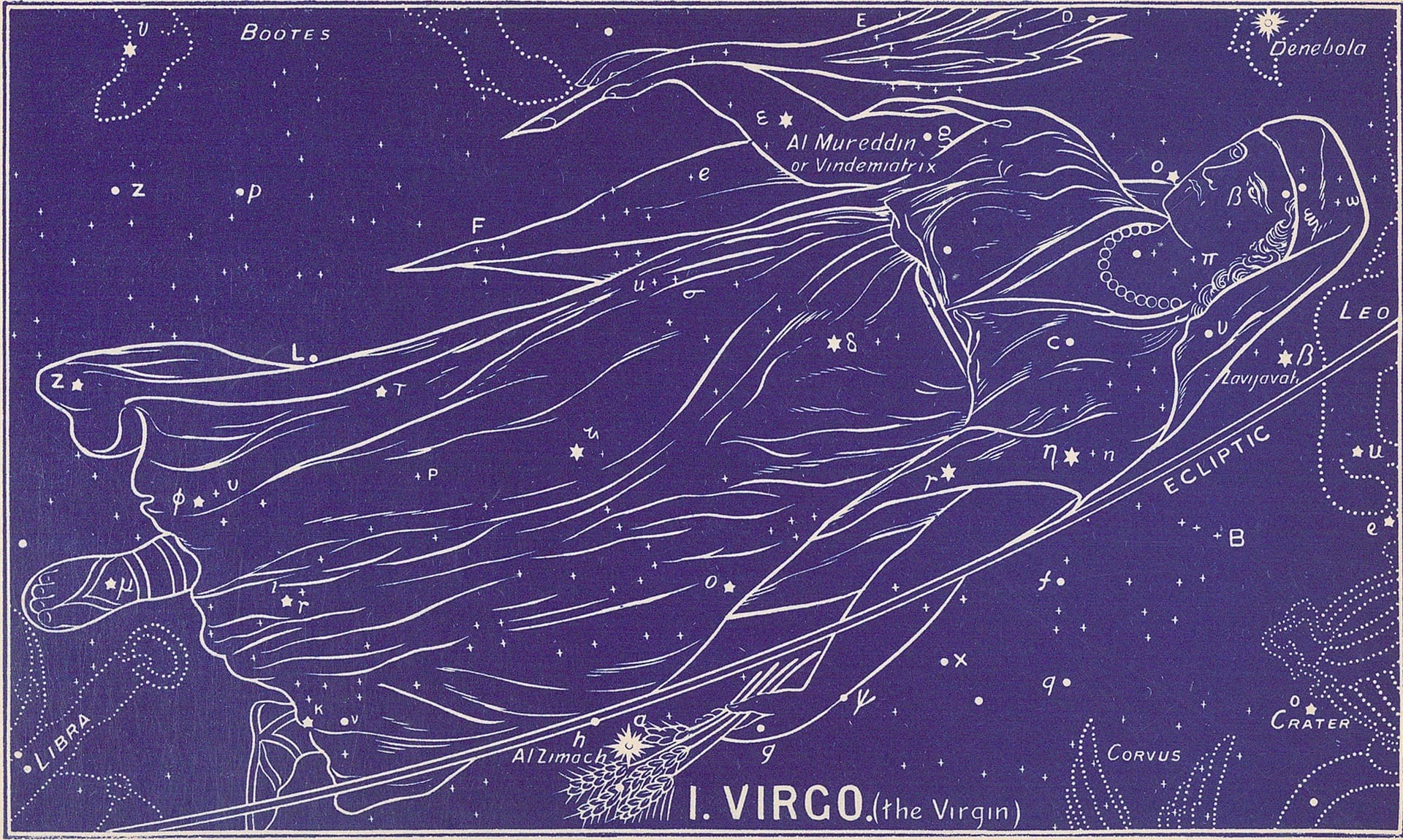
Virgo Constellation [Bullinger]
Bullinger (1893)
The Sign VIRGO.
Virgo is represented as a woman with a branch in her right hand, and some ears of corn in her left hand. Thus giving a two-fold testimony of the Coming One.
The name of this sign in the Hebrew is Bethulah, which means a virgin, and in the Arabic a branch. The two words are connected, as in Latin—Virgo, which means a virgin; and virga, which means a branch (Vulg. Isa. xi. 1). Another name is Sunbul, Arabic, an ear of corn.
It is difficult to separate the Virgin and her Seed in the prophecy, and so, here, we have first the sign Virgo, where the name points to her as the prominent subject; while in the first of the three constellations of this sign, where the woman appears again, the name Coma points to the child as the great subject.
Virgo contains 110 stars, viz., one of the 1st magnitude, six of the 3rd, ten of the 4th, etc.
Thus the brightest star in Virgo (α) has an ancient name, handed down to us in all the star-maps, in which the Hebrew word (צֶמֶח) Tsemech is preserved. It is called in Arabic Al Zimach, which means the branch. This star is in the ear of corn which she holds in her left hand. Hence the star has a modern Latin name, which has almost superseded the ancient one, Spica, which means, an ear of corn. But this hides the great truth revealed by its name Al Zimach. It foretold the coming of Him who should bear this name. The same Divine inspiration has, in the written Word, four times connected it with Him. There are twenty Hebrew words translated “Branch,” but only one of them (Tsemech) is used exclusively of the Messiah, and this word only four times. Each of these further connects Him with one special account of Him, given in the Gospels.
This is the Branch foretold by the star Al Zimach in the ear of corn.
The star β is called Zavijaveh, which means the gloriously beautiful, as in Isa. iv. 2. The star ε, in the arm bearing the branch, is called Al Mureddin, which means who shall come down (as in Ps. lxxii. 8), or who shall have dominion. It is also known as Vindemiatrix, a Chaldee word which means the son, or branch who cometh.
Other names of stars in the sign, not identified, are—
Subilah, who carries. (Isa. xlvi. 4.)
Al Azal, the Branch. (As in Isa. xviii. 5.)
Subilon, a spike of corn. (As in Isa. xvii. 5.)
The Greeks, ignorant of the Divine origin and teaching of the sign, represented Virgo as Ceres, with ears of corn in her hand.
In the Zodiac in the Temple of Denderah, in Egypt, about 2000 b.c. (now in Paris), she is likewise represented with a branch in her hand, but ignorantly explained by a false religion to represent Isis! Her name is called Aspolia, which means ears of corn, or the seed, which shows that though the woman is seen, it is her Seed who is the great subject of the prophecy.
Passing to the three constellations anciently assigned to the sign Virgo, we come to what may be compared to three sections of the chapter, each giving some further detail as to the interpretation of its teaching. [11]
Robson
VIRGO. The Virgin.
Legend. The Virgo constellation is said to represent Erigone, daughter of Icarius, who hanged herself through grief at the death of her father (Bootes). According to other accounts it is Astraea, daughter of one of the Titans, who sided with the Gods against her own father.
Influence. Ptolemy makes the following observations; “The stars in the head of Virgo, and that at the top of the southern wing, operate like Mercury and somewhat like Mars: the other bright stars in the same wing, and those about the girdle, resemble Mercury in their influence, and also Venus, moderately . . . those at the points of the feet and at the bottom of the garments are like Mercury, and also Mars, moderately.” By the Kabalists it is associated with the Hebrew letter Gimel and the 3rd Tarot Trump “The Empress.” [12]
Rigor (1979)
VIRGO: Symbolized by the virgin holding a sheaf of wheat.
MYTHOLOGY: Virgo implies any virtuous woman. She is identified with the Goddess, Rhea, who was the daughter of the Sky and of the Earth, the mother of Jupiter; who represents reason, and the wife of Kronos, the bread giver and the father of time.
VIRGO indicates intellectuality, not necessarily a wise person, and it also indicates a certain amount of self-confidence, and analytical and critical. Where stars in Virgo are outstanding, in particular with Mercury and Venus conjunctions there will be a tendency for those so born to be of a critical nature, even tending towards too much self-criticism, entailing marital difficulties unless the marriage partner is of an unusual nature. Mental harmony is most important to Virgoans.
Negatively; Virgoans are overly cautious, carping, critical; offering criticism that is sharp and damaging. Even though they do not actually mean it to be so, at times their wit is very unfunny. Their love of being methodical generally leads to fussiness and too much conscious of details. They often have an exaggerated idea of cleanliness, a lack of genuine charity, and can fall victim to arrogance and gossip. Their greatest weakness is hypocrisy and they suffer from inner conflicts. They can be tedious and boring to the exasperation of others and they can become full of self-pity.
KEYWORDS for the Virgo constellation:
(+) Positive: Oratorical, discriminating, intellectual, reserved, solidity, clever, self-respecting, critical, exacting.
(–) Negative: Avaricious, indolence, indifference, gossipy, carping, self-conscious, worrying, negativism.
SUN IN VIRGO (+) Endows its natives with practicality, order and harmony, a tendency to be industrious, one who is discriminating, may be of a serving disposition, an analytical mind, a very conscientious person, one who is humane, meticulous, versatile in expression, one who is constructive, critical and quite accurate, a tidy person, one who is ingenious, has keen mental powers, one whose steadiness inspires admiration and respect.
SUN IN VIRGO (–) The native is overly cautious, too timid, has a false sense of intelligence, of an overly critical nature, is prejudiced and narrow in viewpoints, entirely too methodical, has an exaggerated sense of cleanliness, too fussy, immersed in details, one who has a vitriolic tongue, an unfunny wit, one who is hypocritical, a tendency to be snobbish, selfish, and one who seeks self-gratification.
MOON IN VIRGO (+) Endows its natives with a receptive and analytical mind. A retentive memory. A dislike for flattery and ostentation. One who is of a retiring nature. Details important to the native. Native has an acute sense of their own worth and they may wish to be of service. Fluent in speech.
MOON IN VIRGO (–) Native is timid, lacks self-confidence, may develop a ‘carping’ attitude and be too critical, generally over nothing of importance. Native may be a perfectionist and be blind to more important matters or ideas. Native has an unfunny wit.
MERCURY IN VIRGO (+) Endows its natives with a penetrating, questionable mind. The native is of a practical nature, one who has a clear scientific type mind, whose conclusions are well thought out. A studied but utilitarian mind, discriminating, conscientious and industrious. A ‘mental’ worker, versatile and of an adaptable nature; a dextrous disposition. Analytical and tenacious, somewhat skeptical.
MERCURY IN VIRGO (–) One who is irritable, petulant, selfish, thoughtless. One who sees flaws in everything, an inclination towards contrariness. One who is completely skeptical. One who has an unfunny wit and constantly looks for an ulterior motive. A native who is too fussy, over meticulous.
VENUS IN VIRGO (+) Endows its natives with a sense of propriety; proper impulses, appreciation of small niceties. One who is kind and humane, willing to be of service to others with a versatile acquisitive nature. Seldom expresses deep sympathy. A nature that is quiet and pleasant. One with methodical and studious methods. A cheerful person.
VENUS IN VIRGO (–) The native substitutes self-justification for remorse. One who is cold-hearted and inhibited. Introspective. The native tends to conceal their natural inclinations.
MARS IN VIRGO (+) Endows its natives with an industrious, ingenious, versatile mentality. A quick intellect, quick to grasp situations. One who is bold, shrewd, tactful and determined. One with an open-minded disposition, frank and freely offers opinions. A vigorous and effective worker. One who is constructive, versatile and discriminative. Native has a strong tendency to defend one’s right, and is energetic.
MARS IN VIRGO (–) Native is subject to needless worrying. A tendency towards emotional frustration, brooding unnecessarily over illusory troubles. An irritable person, one who is critical of their fellow men, family and friends. A less than honest nature. One who is over-indulgent. Native is subject to procrastination, gets too involved with minor problems and is a busybody. [13]
Noonan (1984)
Virgo is the older, purely allegorical representation of innocence and virtue. Eratosthenes (276?-196 B.C.) identifies her with the Egyptian goddess of nature, Isis. According to early Greek tradition the Sphinx was constructed with Virgo’s head on Leo’s body because the Sun passes through these two signs during the inundation of the Nile. Others, however, have identified Virgo with Ishtar, the Babylonian and Assyrian goddess of fertility. This latter deity is the Astarthe of 3 Kings, xi: 5-33, whom Solomon worshiped to his regret.
Virgo is an unfortunate and sterile sign, signifying barrenness or few children, especially of male issue. Those born under her will be learned and intelligent, and will be good looking. They will have a tendency to be impotent, but will have a kind soul and be an advocate of justice. According to Pliny the appearance of a comet within its borders implied many grievous ills to the female portion of the population.
In physical characteristics those born under Virgo will be medium stout inclining to being tall. They will have long hair and flat noses. Al-Biruni says that they will have moles on their chest and abdomen. Ibn Ezra asserts that they will be attractive in posture, and have broad shoulders and non-curly hair. Modern astrologers add that like Gemini, the Virgo person will keep a youthful appearance will into old age.
The personality of those born under Virgo will be thoughtful, lively, playful, and truthful. They will have good manners, be well-informed, and fond of dance and music. They are liberal in the modern sense of the word, pious, and have a tendency to judge others harshly. Those born in the first decanate will have a pleasing face, will be a writer, and will be an expert in mathematics. Those born in the second decanate will be well bred, candid, endowed with magnanimity and fond of receiving compliments. The third decanate indicates those who will be educated, truly intelligent, humble, and wise.
Modernists claim that the Virgo person is critical and exacting. They are said to tend to neatness in everything, and can have an exaggerated attention to detail. They are altruistic, just persnickety, clever, and intuitive.
Professionally the Virgos will be secretaries, supervisors, ordinary people, dancers, and singers. AL-Biruni assets they will also be viziers and eunuchs. Modern astrologers ass accountants, agents, craftsmen, critics, doctors, teachers, farmers, dieticians, inspectors, and health officers. [14]
Noonan (1990)
The Constellation of the Virgin
Now called Virgo (Vir), this constellation is indicative of an abundance in harvest and a fruitfulness of agriculture in general. But when prominent in the charts of eclipses it portends events concerning kings (heads of state) and in regard can be an ill omen indeed.
Ptolemy asserts that the stars in the head and upon the tip of the southern wing have an effect like that of Mercury and Mars, while the other bright stars in the wing and those about the girdle are like Mercury and Venus. The bright star in the northern wing, called Vindemiatrix, has the nature (according to Ptolemy) of Saturn and Mercury; its spectra, however, is that of Mars. The star Spica is of the nature of Venus and to a lesser degree that of Mars. Here again it is one of the few instances where our spectral classification differs with the ancient designations. In our scheme Spica is a class B star with the nature of Jupiter. Finally, according to Ptolemy the stars inn the tips of the feet and in the train have an effect like Mercury and Mars. [15]
References
- Delta Virginis – Wikipedia.
- Star Names: Their Lore and Meaning, Richard H. Allen, 1889, p.460-473.
- Virgo in Chinese Astronomy – Wikipedia.
- Āpa () – All Skies Encyclopedia.
- SkyEye: (un)Common Star Names.
- Āpaṃvatsa (अपऻऺवत्स) – All Skies Encyclopedia.
- Astronomica, Manilius, 1st century AD, Book 4, X, p.12-13, 26. (Creech, 1700).
- Astronomica, Manilius, 1st century AD, p.237-239, 265. (Goold, 1977).
- Tetrabiblos, Ptolemy, 2nd century AD, Book 1, Chapter 9.
- Mathesis, Firmicus Maternus. @335 AD, Book 5, pp.9-11, 36-39, 54.
- The Witness of the Stars, E. W. Bullinger, 1893, 1. Virgo (the Virgin).
- Fixed Stars and Constellations in Astrology, Vivian E. Robson, 1923, p.66-67.
- The Power of the Fixed Stars, Joseph E. Rigor, 1979, p.123-124, 317, 322, 327, 332, 336-337.
- Classical Scientific Astrology, George Noonan, 1984, pp.72-73.
- Fixed Stars and Judicial Astrology, George Noonan, 1990, p.44-45.