
STARS: Major | All | Constellations | Chinese | About
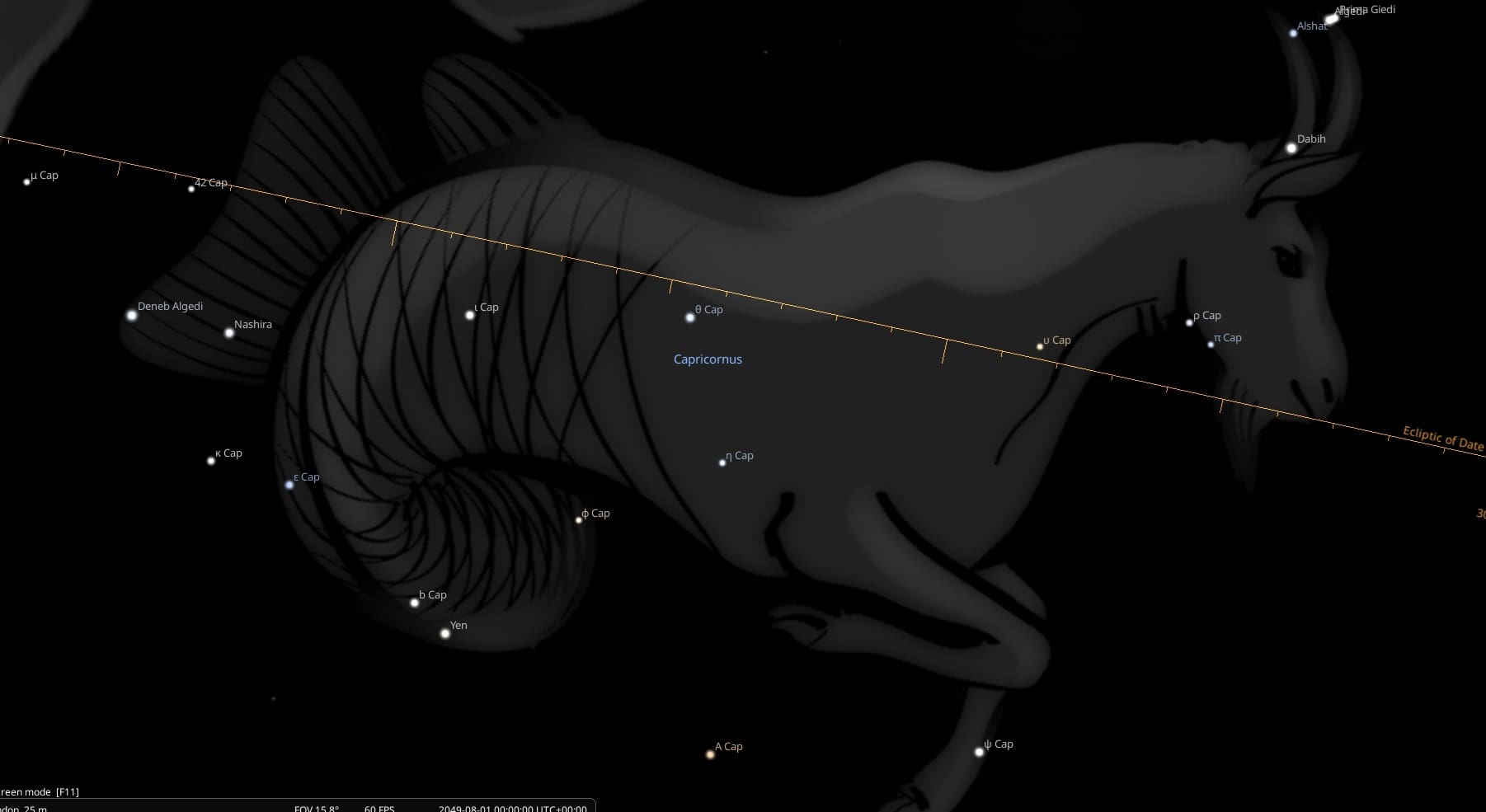
Capricornus Constellation [Stellarium]
Capricornus is one of the 48 constellations listed by Ptolemy in the 2nd century and remains one of the 88 modern constellations. It spans 25 degrees of the zodiac in the Sign of Aquarius.
Abbreviation: Cap
Genitive: Capricorni
Capricornus Constellation Stars
| 2000 | 2050 | Star | Name | Sp. Class | Mag | Orb |
|---|---|---|---|---|---|---|
| 02♒30 | 03♒12 | ξ² Cap | Niususan | F5 | 5.84 | 1°00′ |
| 03♒46 | 04♒28 | α¹ Cap | Giedi Prima | G3 | 4.30 | 1°10′ |
| 03♒51 | 04♒33 | α² Cap | Giedi Secunda | G6 | 3.58 | 1°40′ |
| 04♒03 | 04♒45 | β¹ Cap | Dabih | A5 | 3.05 | 1°50′ |
| 04♒26 | 05♒08 | ν Cap | Alshat | B9 | 4.77 | 1°00′ |
| 04♒43 | 05♒25 | π Cap | Oculus | B4 | 5.08 | 1°00′ |
| 05♒10 | 05♒52 | ρ Cap | Bos | F3 | 4.77 | 1°00′ |
| 05♒13 | 15♒55 | ο Cap | Niusuwu | A1 | 5.94 | 1°00′ |
| 07♒09 | 07♒51 | ψ Cap | Pazan | F5 | 4.13 | 1°20′ |
| 07♒57 | 08♒39 | ω Cap | Baten Algiedi | K4 | 4.12 | 1°20′ |
| 11♒06 | 11♒48 | 19 Cap | Yue | K0 | 5.78 | 1°00′ |
| 11♒53 | 12♒35 | 20 Cap | Zheng | Ap | 6.26 | 1°00′ |
| 12♒44 | 13♒26 | η Cap | Armus | A5 | 4.82 | 1°00′ |
| 13♒17 | 13♒59 | χ Cap | Qi | A0 | 5.30 | 1°00′ |
| 13♒50 | 14♒33 | θ Cap | Dorsum | A1 | 4.08 | 1°20′ |
| 15♒01 | 15♒43 | φ Cap | Chu | K0 | 5.17 | 1°00′ |
| 16♒52 | 17♒34 | 33 Cap | Wei | K0 | 5.38 | 1°00′ |
| 16♒56 | 17♒38 | ζ Cap | Yan | G4 | 3.77 | 1°30′ |
| 17♒27 | 18♒09 | 35 Cap | Han | K3 | 5.78 | 1°00′ |
| 17♒35 | 18♒17 | b Cap | Jin | K0 | 4.50 | 1°10′ |
| 17♒41 | 18♒23 | ι Cap | Dai | G8 | 4.27 | 1°20′ |
| 20♒12 | 20♒54 | ε Cap | Castra | B2 | 4.51 | 1°10′ |
| 21♒47 | 22♒29 | γ Cap | Nashira | A7 | 3.69 | 1°40′ |
| 23♒32 | 24♒15 | δ Cap | Deneb Algiedi | A5 | 2.85 | 2°00′ |
| 25♒50 | 26♒32 | μ Cap | Kuyi | F3 | 5.07 | 1°00′ |
Capricornus Star Names
α¹ Cap is traditionally named Algiedi Prima.
α² Cap is officially named Algedi, from the Arabic al-jady, “the Kid.” Traditionally Algiedi Secunda.
β¹ Cap is officially named Dabih, from the Arabic sa‘d al-al-dhābiḥ, “the Lucky (Stars) of the Slaughterer.”
γ Cap is officially named Nashira, of unknown meaning.
δ Cap is officially named Deneb Algedi, from the Arabic dhanab al-jady, “the Kid’s Tail.”
ε Cap is known as Castra by astrologers, meaning ”a military camp” or “a Fortress” in Latin.
ζ Cap is traditionally named Yan, from the Chinese Yān, an ancient Chinese state. [1]
ζ Cap belongs to the Chinese asterism Shíèrguó, “Twelve States,” representing the “Twelve states of Ancient China.” It has the traditional name Yān, “Yan province.” [2]
Another traditional name for ζ Cap is Marakk, a transcription of the Arabic مراقّ الجدي Marāqq al-Ğady, “the Lower Belly of the Kid.” [3]
Stellarium lists ζ Cap as Yen.
η Cap is known as Armus by astrologers, meaning “Shoulder” in Latin.
θ Cap is known as Dorsum by astrologers, meaning “the Back” in Latin.
ι Cap belongs to the Chinese asterism Shíèrguó, “Twelve States,” representing the “Twelve states of Ancient China.” It has the traditional name Dàiyī, “1st star of Dai province.” [2]
μ Cap belongs to the Chinese asterism Kū, “Crying,” representing “Crying.” It has the traditional name Kūyī, “1st star of Crying.” [2]
ν Cap is officially named Alshat, from the Arabic al‑shāt, “the sheep.” [4]
ν, 4.7, was Kazwini’s Al Shat, the Sheep that was to be slaughtered by the adjacent Dhābiḥ, the stars β. [5]
The name Alshat comes from the traditional Arabic الشاة al-Šāt, “the Sheep,” which tradition has seen as the animal slaughtered by الذابح, “the Sacrificer,” probably linked to the istisqā‘, a prayer for rain from Allāh. Some authors, such as ᶜAbd al-Raḥmān al-Sūfī al-Ṣūfī (964), consider this star part of the 20th manāzil, سعد الذابح Saᶜd al-Ḏābiḥ, “the Favorable of the Sacrificer,” which, in the traditional Arab sky, applies to the pair α and β Cap. [6]
ν Cap belongs to the Chinese asterism Niú, “Ox,” representing “The ox hanged by the rope.” It has the traditional name Niúsùzēngqī, “7th additional star of Ox.” [2]
π Cap is known as Oculus by astrologers, meaning ”Eye” in Latin.
ρ Cap is known as Bos by astrologers, meaning ”Cow” in Latin.
φ Cap is traditionally named Chu, from the Chinese Chŭ, an ancient Chinese state. [1]
φ Cap belongs to the Chinese asterism Shíèrguó, “Twelve States,” representing the “Twelve states of Ancient China.” It has the traditional name Chǔ, “Chu province.” [2]
χ Cap is traditionally named Qi, from the Chinese Qí, an ancient Chinese state. [1]
χ Cap belongs to the Chinese asterism Shíèrguó, “Twelve States,” representing “Twelve states of Ancient China.” It has the traditional name Qí, “Qi province.” [2]
ψ Cap has the traditional name Pazan or Pazhan (پاژن), derived from the Persian word meaning “wild mountain goat.” [7]
ψ Cap belongs to the Chinese asterism Tiāntián, “Celestial Farmland,” representing “Son from heaven.” It has the traditional name Tiāntiánsì, “4th star of Celestial Farmland.” [2]
ψ, 4.3, was Yue, “a Battle‑ax.” [5]
ω Cap is traditionally named Baten Algiedi, from the Arabic بطن الجدي Baṭn al-Ğady, “the Belly of the Kid.” [8]
ω Cap belongs to the Chinese asterism Tiāntián, “Celestial Farmland,” representing “Son from heaven.” It has the traditional name Tiāntiánèr, “2nd star of Celestial Farmland.” [2]
19 Cap is traditionally named Yue, from the Chinese Yuè, an ancient Chinese state. [1]
19 Cap belongs to the Chinese asterism Shíèrguó, “Twelve States,” representing “Twelve states of Ancient China.” It has the traditional name Yuè, “Yue province.” [2]
20 Cap is traditionally named Zheng, from the Chinese Zhèng, an ancient Chinese state. [1]
20 Cap belongs to the Chinese asterism Shíèrguó, “Twelve States,” representing “Twelve states of Ancient China.” It has the traditional name Zhèng, “Zheng province.” [2]
33 Cap is traditionally named Wei, from the Chinese Wèi, an ancient Chinese state. [1]
33 Cap belongs to the Chinese asterism Shíèrguó, “Twelve States,” representing “Twelve states of Ancient China.” It has the traditional name Wèi, “Wei province.” [2]
35 Cap is traditionally named Han, from the Chinese Hàn, an ancient Chinese state. [1]
35 Cap belongs to the Chinese asterism Shíèrguó, “Twelve States,” representing “Twelve states of Ancient China.” It has the traditional name Hán, “Han province.” [2]
36 (b) Cap is traditionally named Jin, from the Chinese Jìn, an ancient Chinese state. [1]
36 Cap belongs to the Chinese asterism Shíèrguó, “Twelve States,” representing “Twelve states of Ancient China.” It has the traditional name Jìn, “Jin province.” [2]
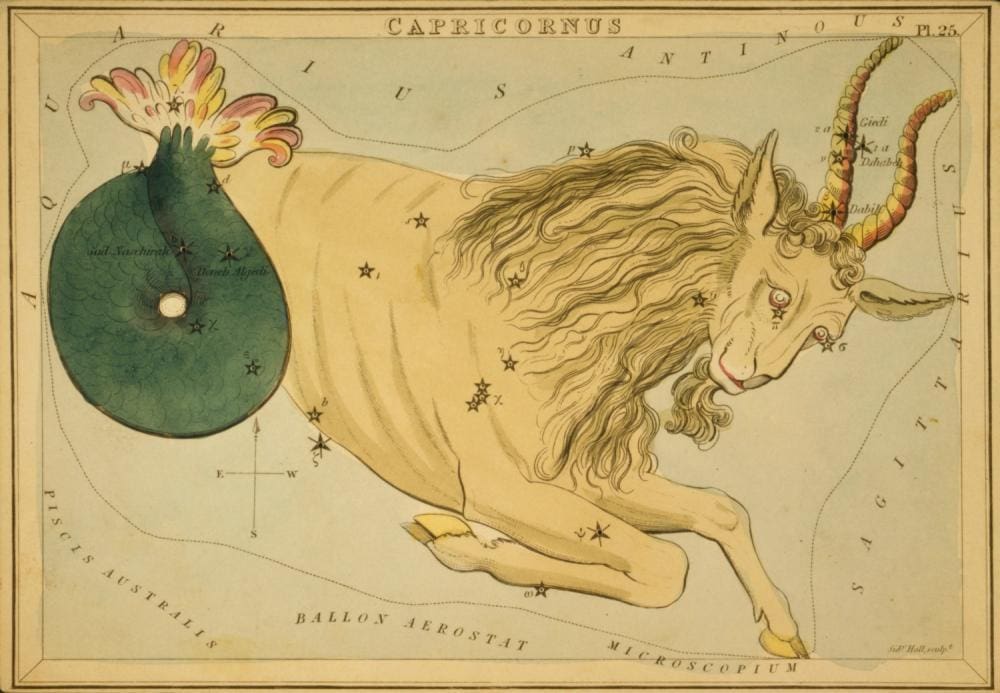
Capricornus Constellation [Urania’s Mirror]
Capricornus Constellation Astrology
Manilius (@ 35 AD)
But Sacred Vesta guards thy fatal Fire,
And thence ’tis guess’d, what Minds thy Rays inspire,
Contracted Goat; by thee that Art’s infus’d,
Which Fire assists, and where a Flame is us’d;
By thee the Miners burn the Womb of Earth,
And see the place of Metals fatal Birth:
By thee they melt; by thee they work the Mould,
Refine, and Stamp it into a mighty Gold:
By thee, the Silver, Iron, Gold, and Brass,
The Forge dissolves, and forms the easie Mass:
By thee, the Ovens heat, and Baths acquire,
And Happy Chymists blow enriching Fire:
Thy Cold (for tho o’re Winder Signs does reign,
Pull’st back the Sun, and send’st Us Day again)
Makes Brokers Rich, for whilst you spraed your Ice,
Their Wares go off, and they enhance the Price:
From thee our Youth unconstant Tempers prove,
And eagerly pursue unlawful Love,
‘Cause Goat above; but these the Fish behind
Corrects in Age, and fixes the soft Mind. [9]
In her shrine Vesta tends your fires, Capricorn: and from her you derive your skills and callings. For whatever needs fire to function and demands a renewal of flame for its work must be counted as of your domain. To pry for hidden metals, to smelt out riches deposited in the veins of the earth, to fold sure-handed the malleable mass – these skills will come from you as will aught which is fashioned in silver or gold. That hot furnaces melt iron and bronze, and ovens give to the wheat its final form, will come as gifts from you. You also give a fondness for clothes and wares which dispel the cold, since your lot falls for all time in winter’s season, wherein you shorten the nights you have brought to their greatest length and give birth to a new year by enlarging the daylight hours. Hence comes a restless quality in their lives and a mind which is often changed and floats this way and that; the first half of the sign is the slave of Venus, and that with guilt involved, but a more virtuous old age is promised by the conjoined fish below. [10]
ASCENDING
But when the narrow Goat erects his Tayl
He drives to Sea, and much inclines to Sail,
Ignoble Trade when Ploughs the dangerous Main,
And precious Life is meanly stak’d for Gain. [9]
The last part of Capricorn, which consists of the sting at the end of its tail, prescribes for its children service upon the seas and the handling of ships, a hardy calling and one which is ever close to death. [10]
Ptolemy (@150 AD)
Of the stars in Capricorn, those in the horns act in the same way as Venus and, in some degree, as Mars; those in the mouth, as Saturn and, in some degree, as Venus; those in the feet and the belly, as Mars and Mercury; and those in the tail, as Saturn and Jupiter. [11]
Maternus (@335 AD)
III.26. Ascendant in Capricorn. If the horoscope is found in Capricorn, he always shows friendship to his friends with pure affection. He will be cunning [and] cheerful, and he will lack nothing for the support of his life. He will travel, and those to whom he has given the sustenance of his life, they will always appear ungrateful to him. He will be amiable, of a small mind, and will always annoy the gods with long and prolix prayers. He will be such as has an abundance of substance and ability. He will be bound by feminine lusts, and who, having fulfilled his lusts, will strive to blame these same women, learning the secrets of some sacrament or of sacred things or of the life of another or of hidden religions.
27. If he is in Libra MC., he will be pious, honest, adorned with the grace of speech, learned. He will repay his vows to the gods, freed from certain necessities or from certain dangers. He will have prosperous actions, but after being oppressed by evil actions, happiness will be conferred on him by the misfortunes of others, and he will have profit from the deaths of others, or he will find the advantages of happiness from some old and hidden matter.
28. If he is set in Cancer, he will have great troubles from relatives, and will be involved in great dangers. If he is in Aries IMC., he will be in great errors, and after an inconvenient life he will be destined for rest, but his life will be changed by the variety of his actions. For he will be now in a high degree of dignity, now he is recalled to the lowest with the fall of dignity. But this inequality arises for him from the friendships of the powerful. He brings up a wife and his first son, or certainly whoever is born a son will be seriously weakened by a serious health defect.
III.44. Saturn in Capricorn. Whoever has it in the tropical regions, their entire substance and their entire destiny will be changed by constant decline. For whenever they approach the highest degree of happiness, they will always fall by some deceptive reason, and will be held by the inequalities of misfortunes as long as Saturn has completed the <first> circle of his course, or as long as he has spent the power of his time.
45. They will go through these life’s crises as long as Saturn has passed through Gemini and Cancer. They will indeed be such as to hope to have the greatest resources of wealth, but nothing great in store *****, but having the idea of wealth, they are deterred by domestic distress; their paternal and maternal substance will also be dissipated. But whatever they have undertaken, they will lose at this time for various reasons, and will diminish all their substance.
45. They will also be placed in peregrinations <and> in sickness, and they will have life’s crises in both the 5th and 7th and 9th years of age, especially when this number of years has tripled. For then they will be in sickness, in losses, in crowds, in pains, in injuries. They will also be drowned in the greatest misfortunes, unless they are relieved by the protection of the benevolent stars. For then there will be misfortunes, then poverty, and all the other things that we have said, if no protection of the benevolent stars breaks the onslaught of these evils. But they will be in these evils as long as Saturn, having entered his places, comes to the right trine.
47. But when he is placed in Capricorn in every way, when he comes to Gemini and Cancer, all He decrees the inconveniences of contrariety. But when he is in Leo and in the part in which Capricorn is placed, then he decrees the greatest acts and the increases of prosperous happiness. But not even when placed in this sign does he give a virgin as a wife, but he always separates her either by divorce or by death. But whatever women were first betrothed to them, he does not suffer them to remain the same, or to persevere in marriage. But wives who have been raped by others are destined to be given birth to. But these men have children from two women, but they will still have pains from the constant deaths of their children, or their children will be denied them forever.
48. But they will have pains and illnesses either in the outer parts of their bodies, or in hidden and necessary things. But they incur the greatest storms of life and the greatest dangers when Saturn has entered Cancer. But when he has made a transition to Leo, freed from these storms, they achieve the peaceful joy of serenity with the greatest increase of happiness. For then Saturn bestows rest, then increases in money, then substance, then health, then joy, then a right order of life, all misfortunes having been put to rest.
IV.24. Jupiter in Capricorn. Whoever has Jupiter in Capricorn will be glorious friends of powerful friends, keeping their secrets with faithful silence. They will be happy but when Jupiter has filled the spaces of the second course. For before this time, whatever honor he may have been in, he is cast down from the power of that honor, and they will be in distress and in the most difficult acts, notations, humility, serving the most humble men, so long as Saturn passes through the second trine of the sign of the same [place].
25. For before this time they will be involved in many sorrows and losses and causes and contradictions, and they will see the deaths of their loved ones, and they will be involved in many misfortunes, and they will be placed in such great unhappiness that they will desire to be freed from this continuation of evils by death. But when Saturn has passed through these places which we have mentioned, excluding all evils. And those who sleep will attain the greatest benefits of happiness, and, having been relieved by the conversations of many, will be placed in charge of great faculties, according to the strength and substance of their procreation. [12]
Allen (1889)
Capricornus,
The common Latin name was varied by the Caper of Ausonius, flexus Caper of Manilius, Hircus corniger of Vergil, hircinus Sidus of Prudens, Capra and aequoris Hircus, “the Sea Goat;” while Minsheu’s “Capra illa Amalthea” indicates that it was identified by some with the goat usually assigned to Auriga. All this, doubtless, was from oriental legends, perhaps very ancient, which made Capricorn the nurse of the youthful sun-god that long anticipated the story of the infant Jupiter and Amalthea. The Latin poets also designated it as Neptuni proles, “Neptune’s offspring;” Pelagi Procella, “the Ocean Storm;” Imbrifer, “the Rain-bringing One;” Signum hiemale, and Gelidus, because then at the winter solstice, the equivalent Ἀθαλπής appearing with the Greeks, which Riccioli repeated as Athalpis.
Aratos called it Ἀιγοκέρως, “the Horned Goat,” to distinguish it from the Ἀιξ of Auriga, as did Ptolemy… Eratosthenes knew it as Πάν, and Ἀιγι‑Πᾶν, “the Goat-Footed Pan,” half fishified, Smyth said, by his plunge into the Nile in a panic at the approach of the monster Typhon; the same story being told of Bacchus, so that he, too, always was associated with its stars.
In Persia it was Bushgali, Bahi or Vahik, and Goi; in the Pahlavi tongue, Nahi; in Turkey, Ughlak; in Syria, Gadjo; and in Arabia, Al Jady, usually written by us Giedi; all meaning “the Goat,” or, in the latter country, “the Bādan, or Ibex,” known to zoologists as Capra beden. Burritt’s Tower of Gad, at first sight presumably Hebrew, would seem rather to be a bungled translation from the Arabic, and in no way connected with the Jewish tribe.
Very frequent mention was made of this constellation in early days, for the Platonists held that the souls of men, when released from corporeity, ascended to heaven through its stars, whence it was called the Gate of the Gods; their road of descent having been through Cancer. But some of the Orientals knew it as the Southern Gate of the Sun, as did the Latins in their altera Solis Porta. Berōssōs is reported by Seneca to have learned from the old books of Sargon that the world would be destroyed by a great conflagration when all the planets met in this sign.
In astrology, with Taurus and Virgo, it was the Earthly Trigon, and black, russet, or a swarthy brown, was the color assigned to it; while, with Aquarius, it was the House of Saturn, as that planet was created in this constellation, and whenever here had great influence over human affairs; as Alchabitus asserted, in the Ysagogicus of 1485, caput et pedes habet; and it always governed the thighs and knees. It also was regarded as under the care of the goddess Vesta, and hence Vestae Sidus. Ampelius singularly associated it with the burning south wind Auster, and Manilius said that it reigned over France, Germany, and Spain; in later times it ruled Greece, India, Macedonia, and Thrace, Brandenburg and Mecklenburg, Saxony and Wilna, Mexico and Oxford. Manilius also wrote of it as in our motto, and “at Caesar’s Birth Serene he shone.”
The almanac of 1386 has: “Whoso is borne in Capcorn schal be ryche and wel lufyd;” in 1542 the Doctor, as Arcandum was called, showed that a man born under it would be a great gallant, would have eight special illnesses, and would die at sixty; and according to Smyth it was “the very pet of all constellations with astrologers, having been the fortunate sign under which Augustus and Vespasian were born,” although elsewhere, in somewhat uncourtly style, he quotes: “prosperous in dull and heavy beasts.” It also appears to have been much and favorably regarded by the Arabians, as may be seen in their names for its chief stars, and in the character assigned by them to its lunar mansions. But these benign qualities were only occasional, caused probably by some lucky combination with a fortunate sign, as is known only to the initiated, for its general reputation was the reverse; and, in classical days, when coincident with the sun, it was thought a harbinger of storms and so ruler of the waters. Ovid expressed much the same opinion in connection with the story of Acaetes; but ages before them this seems to have been said of it on Euphratean tablets.
Suetonius in his Life of Augustus, and Spanheim in his De Nummis, said that Capricorn was shown on silver coins of that emperor, commemorating the fact that it was his natal sign; and it always has been regarded in astrology as the Mansion of Kings. It is seen, too, on a coin found in Kent, struck by the British prince Amminius, and was the most frequent of the zodiacal figures on uranographic amulets of the 14th and 15th centuries, “worn as a kind of astral defensive armor.”
Some connect the sign in Egyptian astronomy with Chnum, Chnemu, Gnoum, or Knum, the God of the Waters, associated with the rising of the Nile and worshiped in Elephantine at the Cataracts, this divinity bearing goat’s, not ram’s, horns. Others have said that it was the goat-god Mendes; and La Lande cited the strange title Oxirinque from the Greek adjective descriptive of a Swordfish, our constellation sometimes being thus shown, when it was considered the cause of the inundation. In Coptic Egypt it was Ὀπέυτυς, Brachium Sacrificii; “The Arm of Sacrifice,” and Miss Clerke says that it was figured in that country as a Mirror, emblematic of life.
Sayce, Bosanquet, and others think that they have without doubt identified it with the Assyrian Munaχa, “the Goat-Fish;” and we see other probable names in Shah or Shahu, the Ibex, and in Niru, the Yoke, this last perhaps a popular one. Brown gives for it the Akkadian Su‑tul of the same meaning; and another possible title, resembling the early Hindu, was Makhar, claimed also for Delphinus. It seems likewise to have been known as the Double Ship. Jensen says that “the amphibious Ia Oannes of the Persian Gulf was connected with the constellation Capricornus”; Sayce, that a cuneiform inscription designates it as the Father of Light, — a title which, astronomically considered, could not have been correct except about 15,000 years ago, when the sun was here at the summer solstice; that “the goat was sacred and exalted into this sign”; and that a robe of goatskins was the sacred dress of the Babylonian priests. So that, although we do not know when Capricornus came into the zodiac, we may be confident that it was millenniums ago, perhaps in prehistoric days. It was identified with the 10th Assyrian month Dhabitu, corresponding to December-January.
Its symbol, ♑, usually is thought to be τρ, the initial letters of τράγος, ”“Goat,” but La Lande said that it represents the twisted tail of the creature; and Brown similarly calls it “a conventional representation of a fish-tailed goat.” Indeed it is not unlike the outline of these stars on a celestial globe. [5]
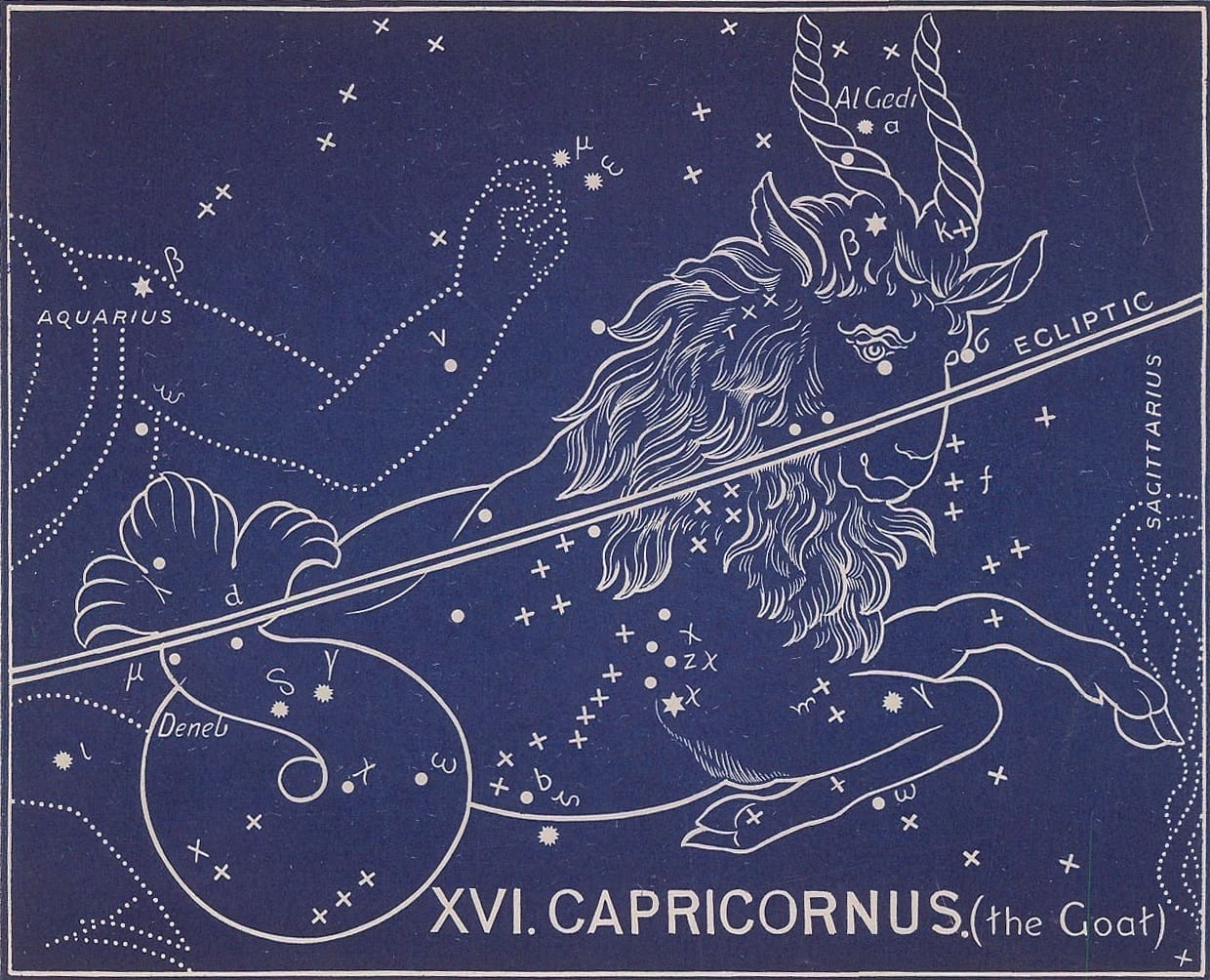
Capricornus Constellation [Bullinger]
Bullinger (1893)
The Sign CAPRICORNUS (The Sea Goat).
It is most noteworthy that this Second Book opens with the Goat, and closes with the Ram: two animals of sacrifice; while the two middlechapters are both connected with fishes.
In all the ancient Zodiacs, or Planispheres, we find a goat with a fish’s tail. In the Zodiacs of Denderah and Esneh, in Egypt, it is half-goat and half-fish, and it is there called Hu-penius, which means the place of the sacrifice.
In the Indian Zodiac it is a goat passant traversed by a fish.
There can be no doubt as to the significance of this sign.
In the Goat we have the Atoning Sacrifice, in the Fish we have the people for whom the atonement is made. When we come to the sign “Pisces” we shall see more clearly that it points to the multitudes of the redeemed host.
The Goat is bowing its head as though falling down in death. The right leg is folded underneath the body, and he seems unable to rise with the left. The tail of the fish, on the other hand, seems to be full of vigour and life.
The Hebrew name of the sign is Gedi, the kid or cut off, the same as the Arabic Al Gedi. Capricornus is merely the modern (Latin) name of the sign, and means goat.
There are 51 stars in the sign, three of which are of the 3rd magnitude, three of the 4th, etc. Five are remarkable stars, α and β in the horn and head, and the remaining three, γ, δ, and ε, in the fishy tail. The star α is named Al Gedi, the kid or goat, while the star δ is called Deneb Al Gedi, the sacrifice cometh.
Other star-names in the sign, not identified, are Dabih (Syriac), the sacrifice slain; Al Dabik and Al Dehabeh (Arabic) have the same meaning; Ma’asad, the slaying; Sa’ad al Naschira, the record of the cutting off. [13]
Robson (1923)
CAPRICORNUS. The Goat.
Legend. During their war with the giants, the Gods were driven into Egypt and pursued by Typhon. In order to escape, each was forced to change his shape, and Pan, leaping into the Nile, turned the upper part of his body into a goat and the lower part into a fish, a shape considered by Jupiter worthy of commemoration in the heavens.
Influence. Ptolemy’s observations are as follows “The stars in the horns of Capricorn have efficacy similar to that of Venus, and partly to that of Mars. The stars in the mouth are like Saturn, and partly like Venus: those in the feet and in the belly act in the same manner as Mars and Mercury: those in the tail are like Saturn and Jupiter.” By the Kabalists this constellation is associated with the Hebrew letter Yod and the 10th Tarot Trump “The Wheel of Fortune.” [14]
Rigor (1979)
LEO: Symbolized by the Sea Goat, a goat with the tail of a fish.
MYTHOLOGY: The grim reaper presides over this sign, and through its gateway, the souls of men, released at death pass on to the hereafter. But, like the Sun, when it enters this sign, they are born anew, for after 22 December, the days increase in length and the Sun appears to grow stronger each day.
Pan, the gods of shepherds and rural scenery, terrorized the people by his mere presence. Jupiter, the father of gods, gave one of his goats horns to the nymphs who nursed him in his infancy. This horn was endowed with magical virtues, and whatever the holder desired would be provided for him and therefore was called Cornucopia, the ‘horn of plenty.’ Everything in plenty or nothing at all, was the desire of the horn holders.
CAPRICORN is endowed with an aspiring, determined, serious mind, considerable reserve and self-control and greatly interested in acquisition. They have the ability to scale the heights, the ability to manage and direct others and for others, but when under bad directions, many pitfalls await the Capricornian. They are careful, cautious, and farseeing as far as they are concerned, inclined to be serious, have the ability to command and direct, and command the respect of friends, yet fail to hold their respect and benevolent feelings. Sudden and unexpected losses while under adverse conditions may be experienced, but equally good fortune awaits under good directions.
Negatively; Capricorns waste time being moody and have a tendency towards being indecisive; they tend to take advantage of others, they can be downright greedy and selfish, and at times, they are carried away by their own thriftiness. They tend to be severe with themselves and others, and people generally think of them as being cold and aloof. They can be hard to please and tend to have a calculating nature.
KEYWORDS for the Capricornus constellation:
(+) Positive: Self-reliant, independent, ambitious, conservative, persevering, practical, grave and sober, determined, disciplinarian, indefatigable.
(–) Negative: Uncompromising, schemer, abrasive, proud, selfish, ultra-conservative, ruthless, vindictive, intolerant, Severe.
SUN IN CAPRICORNUS (+) Endows its natives with extreme patience, perseverance and reliability. One who is modest in their tastes, one who is trustworthy and has a serious cautiously forceful nature. One who is economical, conservative. Fond of ‘old things’, old ideas. Has the ability to exercise great control over themselves. One who is thoughtful of others, is very industrious and thrives on hard work. Native has great self-confidence, is of a very ambitious nature, grasps at every opportunity, has the ability to organize and direct. One who is self-reliant, cool-headed and able to take measured deliberate action.
SUN IN CAPRICORNUS (–) The native is prone to take advantage of others, a very rigid outlook, one who develops greed, becomes too selfish, too moody at times, somewhat pessimistic and carried away by being too thrifty. Native may become severe in their dealings and be standoffish. They are capable of ignoring friends, being entirely too materialistic and unable to see anyone’s viewpoint but their own. One who is too exacting, mean.
MOON IN CAPRICORNUS (+) Endows its natives with social and public preferment. Native subject to honors, may attain some prominence, gain the ability to inspire confidence, become a good organizer, develop a cautious and reserved nature. Have an interest in material things. Practical and materialistic. Native is generally ambitious, seeks after money and power. Ability to lead and direct.
MOON IN CAPRICORNUS (–) Native is overly cautious, may be subject to scandals, or engage in scandalous actions. Entertains a great fear of poverty, may become avaricious and even miserly, generally expresses little feeling for others. Native may be gloomy, have a vague and rather indeterminate mentality; they seem to attract emnity. Native is generally shy and insecure, overly sensitive. Native may develop a carping attitude, claculate to gain power at all costs.
MERCURY IN CAPRICORNUS (+) Endows its natives with a critical, dextrous, penetrating mentality. One who may be honest and trustworthy, diplomatic and cautious. One who is economical with a rational serious mind. A cool, calculating person. One who is discriminative and a wavering attitude. Lacks tact and subject to unfaithfulness, inclination for thrift. A reasonable person. Methodical in decision-making. A sound grasp for logic and a good memory.
MERCURY IN CAPRICORNUS (–) The native may be fickle, inconstant, miserly, restless, malicious, vindictive and spiteful. One who is narrow-minded and a tendency to be cruel and hard. An inconsiderate person.
VENUS IN CAPRICORNUS (+) Endows its natives with the tendency towards being melancholy, but great faithfulness. One who never feels secure. It augurs a high social standing. Natives nature is cautious, but ambitious and diplomatic. Losses through treachery or their own bad judgment is possible. Generally marriage is a source of some sorrows and disappointments. These natives instinctively do the ‘right thing’ and their emotional responses may be self-repressed.
VENUS IN CAPRICORNUS (–) Native develops a cold, hard approach in their dealings. They may be cold and stern. Difficult to express affections. Unions may be for convenience or social pleasures. Liable to losses, treachery, petty annoyances, small troubles. Native may be too demanding.
MARS IN CAPRICORNUS (+) Endows its natives with ambition, self-reliance, a bold and enterprising nature. One who is brave and faithful. Has indomitable courage and an inexhaustible energy. One with plenty of patience and perseverance, overcomes all obstacles. An interest in disciplines and with a constructive and thrifty mentality. One capable of assuming responsibility, a good organizer. Mentally subtle, somewhat intuitive.
MARS IN CAPRICORNUS (–) Native tends to be too dominant, too irritable. One who easily experiences conflict with family and/or authorities. Native entertains great ambition to excell and succeed. One who is rash, impulsive and headstrong, lacks persistence and perseverance. Native is quick to anger, arouses opposition, can suffer from dishonour. A cold person. [15]
Noonan (1984)
In ancient Babylon, Capricorn was an amphibious character—the Sea-Goat. In later times, Ptolemy and his contemporaries had the sign as a complete goat-like animal. But in astrology, Capricorn has always been regarded as the “Mansion of Kings.” The goat was the natal sign of the emperor Augustus, and Capricorn was shown on the silver coins of that emperor. The sign was also frequently on uranographic amulets of the 14th and 15th centuries, and was worn as a kind of “astral defense armor.” The Platonists held that the souls of men ascended to heaven through the stars of Capricorn, when the sign was called the “Gate of the Gods,” and the old book of Sargon asserted that the world would be destroyed by a great conflagration when all the planets were in conjunction in this sign.
Those born under the sign of Capricorn will be irascible and destructive. At times, their actions will seem futile, and they will lack energy. They are endowed with education, deceit, and great sorrow. The almanac of 1386 has: “whoso is borne in Capricorn shal be ryche and we lufyed.” Capricorn is the very pet of all signs with classical astrologers through the ages. It is extremely fortunate, and both the emperors Augustus and Vespasian were born in the sign of Capricorn. Ibn Ezra maintains that Capricorn natives will acquire great wealth through kings, but that they are also “addicted to sexual intercourse and fornication, will have a large family including twins, and that they will be subject to a serious mishap because of a woman.” A 16th century astrologer claimed a man born under this sign “would be a great gallant, would have eight special illnesses, and would die at sixty.” Traditionally, the first part of Capricorn indicates sterility, while the last part presages the birth of twins. Al-Biruni says that the forearms of Capricorn and Scorpio indicate hermaphroditism. It is said that those born under this sign will also be eager for marriage.
The Capricornian person will have a slender and erect body, a fine figure, and a goat-like face with wide eyes and crooked ears. They will have little hair, thin legs, and an active gait. Men will have a longish beard and will be handsome. Modern astrologers add that the native will have a bony look, especially about the knees and knuckles, and the Modernists say that there is apt to be long, deep creases on the sides of the mouth.
Those born under this sign will be arrogant, impetuous, changeable, anxious, quarrelsome, opinionative, fond of games and life, crafty, forgetful, and bold. Al-Biruni adds false, choleric, and evil-thinking. Those born in the first decanate will be intelligent, modestm refined, and magnanimous; in the second decanate, the native will have the intention of doing evil, and will be irascible but ingratiating; and in the third decanate, he will be easily aroused to anger, will abhor evil and long for the companionship of the opposite sex. He will also be refined and sociable if born in the third decanate of Capricorn.
In modern astrology, the Capricornian is said to be self-reliant, refined, oratorical, prudent, cautious, proud, selfish, deep-thinking, independent, and can sometimes become mean and miserly. Overall, however, their personality can generally be described as magnetic.
In classical times, the professions of those born under the sign of Capricorn included hunters and slaves. Modern astrologers add civil servants, mathematicians, osteopaths, and politicians. [16]
Noonan (1990)
The Constellation of the Goat
Capricorn (Cap), the constellation, has a great influence over human affairs, portending major changes in such areas as climate and political customs. Along with the sign, the constellation is also noted as the “Mansion of Kings.” Unfavorably situated with regard to lunar eclipses, it indicates major storms, especially at sea. Of the stars, Tetrabiblos asserts that those in the horns act in the same way as Venus and Mars, and those in the mouth as Saturn, and, to some degree, as Venus. Those in the feet and belly act as Mars and Mercury, and those in the tail have a nature akin to that of Saturn and Jupiter. [17]
References
-
- SkyEye: (Un)Common Star Names – Alternative Names.
- Capricornus in Chinese astronomy – Wikipedia.
- Zeta Capricorni – French Wikipedia.
- SkyEye: (Un)Common Star Names – Official Names.
- Star Names: Their Lore and Meaning, Richard H. Allen, 1889, p.135-142.
- Nu Capricorni – French Wikipedia.
- Psi Capricorni – Indonesian Wikipedia.
- Omega Capricorni – French Wikipedia.
- Astronomica, Manilius, 1st century AD, Book 4, X, p. 14-15, 25. (Creech, 1700).
- Astronomica, Manilius, 1st century AD, book 4, pp. 241-243, 267. (Goold, 1977).
- Tetrabiblos, Ptolemy, 2nd century AD, Book 1, Chapter 9.
- Mathesis, Firmicus Maternus. @335 AD, Book 5, pp.14-15, 44-45, 57-58.
- The Witness of the Stars, E. W. Bullinger, 1893, CAPRICORNUS (The Sea Goat).
- Fixed Stars and Constellations in Astrology, Vivian E. Robson, 1923, p.35-36.
- The Power of the Fixed Stars, Joseph E. Rigor, 1979. p.181-182, 319, 324, 328-329, 333, 338.
- Classical Scientific Astrology, George Noonan, 1984, pp. 77-78.
- Fixed Stars and Judicial Astrology, George Noonan, 1990, p.51.