STARS: Major | All | Constellations | Chinese | About
25♐56 to 02♒30
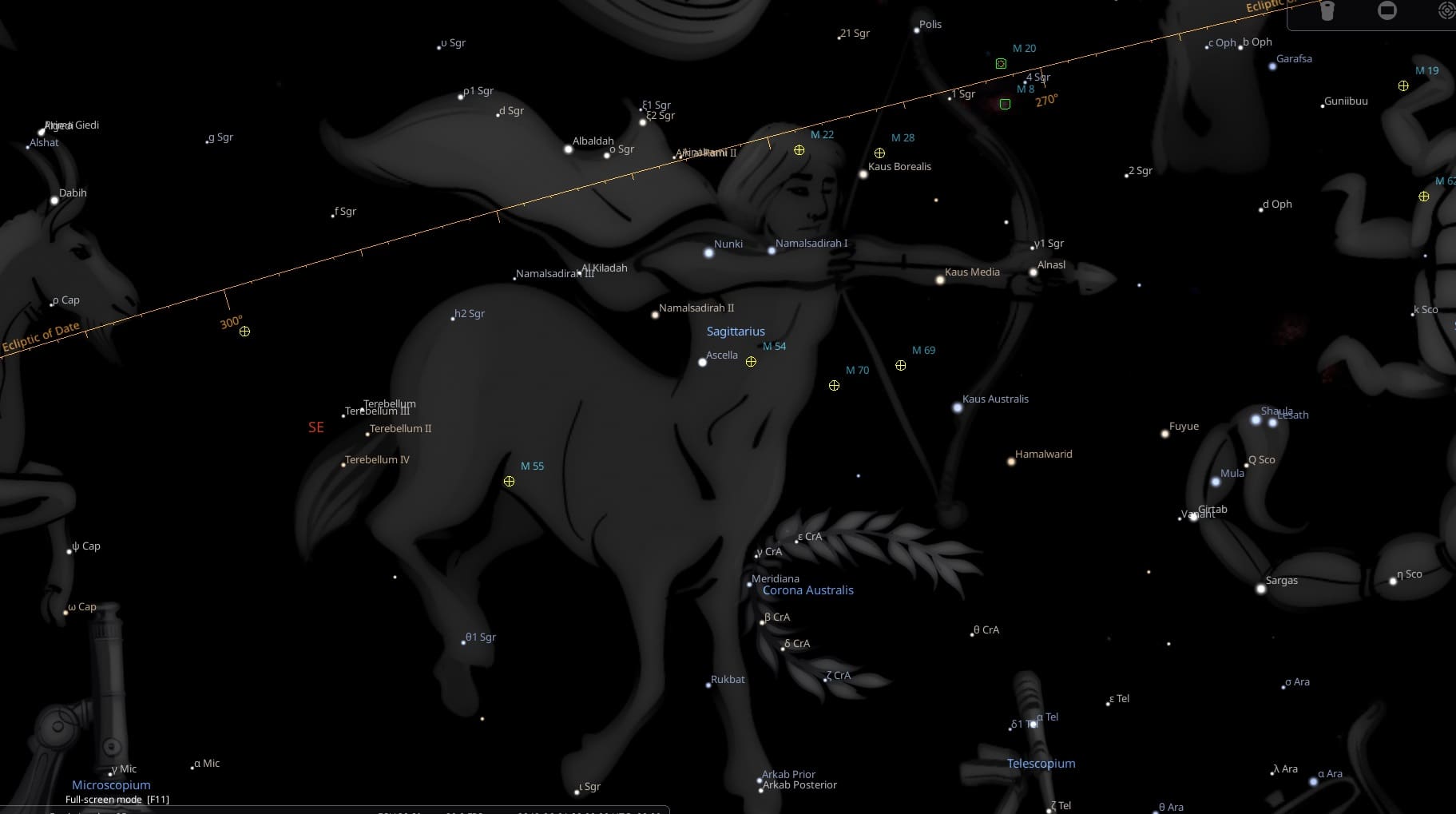
Sagittarius Constellation [Stellarium]
Sagittarius is one of the 48 constellations listed by Ptolemy in the 2nd century and remains one of the 88 modern constellations. It spans 30 degrees of the zodiac in the Sign of Capricorn.
Abbreviation: Sgr
Genitive: Sagittarii
Sagittarius Constellation Stars
| 2000 | 2050 | Star | Name | Sp. Class | Mag. | Orb |
|---|---|---|---|---|---|---|
| 26♐51 | 27♐33 | Sgr A* | Sagittarius A* | 1°00′ | ||
| 27♐14 | 27♐56 | X Sgr | F7 | 4.53 | 1°10′ | |
| 00♑37 | 01♑19 | M20 | Triffid Nebula | 6.30 | 1°00′ | |
| 00♑49 | 01♑31 | M8 | Spiculum | 6.00 | 1°00′ | |
| 01♑06 | 01♑48 | γ1 Sgr | Nash | G0 | 4.66 | 1°00′ |
| 01♑15 | 01♑57 | γ2 Sgr | Alnasl | K0 | 2.98 | 1°50′ |
| 03♑12 | 03♑55 | μ Sgr | Polis | B2 | 3.84 | 1°30′ |
| 03♑37 | 04♑19 | η Sgr | Hamalwarid | M2 | 3.10 | 1°50′ |
| 04♑35 | 15♑17 | δ Sgr | Kaus Media | K3 | 2.72 | 2°00′ |
| 05♑04 | 05♑46 | ε Sgr | Kaus Australis | B9 | 1.79 | 2°20′ |
| 06♑19 | 07♑01 | λ Sgr | Kaus Borealis | K1 | 2.82 | 2°00′ |
| 08♑18 | 09♑01 | M22 | Facies | 5.10 | 1°00′ | |
| 09♑12 | 09♑54 | HD172910 | Nóngzhàngrén | B2 | 4.86 | 1°00′ |
| 10♑11 | 10♑53 | φ Sgr | Tianfu | B8 | 3.17 | 1°50′ |
| 12♑23 | 13♑05 | σ Sgr | Nunki | B2 | 2.05 | 2°10′ |
| 12♑28 | 13♑10 | ν1 Sgr | Ainalrami | K1 | 4.86 | 1°00′ |
| 12♑42 | 13♑24 | ν2 Sgr | Ain al Rami II | K1 | 5.00 | 1°00′ |
| 13♑38 | 14♑20 | ζ Sgr | Ascella | A3 | 2.60 | 2°00′ |
| 14♑50 | 15♑32 | τ Sgr | Namalsadirah II | K1 | 3.32 | 1°40′ |
| 14♑59 | 15♑42 | ο Sgr | Manubrium | K0 | 3.76 | 1°30′ |
| 15♑46 | 16♑28 | β1 Sgr | Arkab Prior | B9 | 3.96 | 1°30′ |
| 15♑50 | 16♑32 | β2 Sgr | Arkab Posterior | F2 | 4.27 | 1°20′ |
| 16♑15 | 16♑57 | π Sgr | Albaldah | F2 | 2.88 | 2°00′ |
| 16♑38 | 17♑20 | α Sgr | Rukbat | B8 | 3.96 | 1°30′ |
| 17♑02 | 17♑45 | ψ Sgr | Alkiladah | K0 | 4.86 | 1°00′ |
| 17♑11 | 17♑53 | HD179949 | Gumula | F8 | 6.25 | 1°00′ |
| 19♑20 | 20♑02 | χ1 Sgr | Namalsadirah III | A4 | 5.02 | 1°00′ |
| 19♑27 | 20♑09 | ρ1 Sgr | F0 | 3.92 | 1°30′ | |
| 19♑28 | 20♑10 | χ3 Sgr | Namalsadirah IV | K3 | 5.45 | 1°00′ |
| 19♑43 | 20♑25 | υ Sgr | B2 | 4.52 | 1°10′ | |
| 22♑33 | 23♑15 | ι Sgr | K0 | 4.12 | 1°20′ | |
| 24♑52 | 25♑24 | θ1 Sgr | B3 | 4.37 | 1°10′ | |
| 25♑51 | 26♑33 | ω Sgr | Terebellum | G3 | 4.70 | 1°00′ |
| 25♑55 | 26♑37 | 59 Sgr | Terebellum II | K3 | 4.54 | 1°10′ |
| 26♑33 | 27♑15 | 60 Sgr | Terebellum III | G8 | 4.84 | 1°00′ |
| 27♑04 | 27♑46 | 62 Sgr | Terebellum IV | M4 | 4.43 | 1°10′ |
Sagittarius Star Names
α Sgr is officially named Rukbat, from the Arabic rukbat ur‑rāmī, “the Archer’s Knee.”
β¹ Sgr is officially named Arkab Prior, from the Arabic/Latin al‑ʿarqūb / prior, “the hamstring.” [1]
Applied in recent times from an abbreviation of its modern Arabic name ‘urqūb al-rāmī, “the Archer’s Achilles Tendon.” [2]
β¹, Double, 3.8 and 8, and β², 4.4. Arkab and Urkab are from Al᾽Urḳūb, translated by Ideler as “the Tendon uniting the calf of the leg to the heel,” and this coincides with their location in the figure on modern maps, as well as with their Euphratean title Ur-ner‑gub, “the Sole of the Left Foot;” but Al Sufi and the engraver of the Borgian globe assigned these stars to the rear of the horse’s body.
Kazwini knew α and the two betas as Al Ṣuradain, “the two Surad,” desert birds differently described, — by some as “larger than sparrows” and variegated black and white (magpies?); by others as yellow and larger than doves. [3]
β¹ Sgr belongs to the Chinese asterism Tiānyuān, “Celestial Spring,” representing “Pond in the sky.” It has the traditional name Tiānyuānèr, “2nd star of Celestial Spring.” [4]
β² Sgr is officially named Arkab Posterior, from the Arabic/Latin al‑ʿarqūb / posterior, “the hamstring.” [1]
β² Sgr belongs to the Chinese asterism Tiānyuān, “Celestial Spring,” representing “Pond in the sky.” It has the traditional name Tiānyuānyī, “1st star of Celestial Spring.” [4]
γ¹ Sgr is known as Nash. [5] Probably from Nushaba (see γ² Sgr).
γ² Sgr is officially named Alnasl, from the Arabic an-naşl, “the blade.” [1]
Applied in recent times from its late Arabic name an-naşl, “the Point,” in turn an abbreviation of the Arabic Almagest’s an-naşl al-sahm, “the Point of the Arrow.”
or Nushaba
Applied in recent times from its late Arabic name zujj al-nushshāba, “the [Iron] Point of the [Wooden] Arrow,” cited in Renaissance discussion of Sagittarius. [2]
γ, 3,1, yellow. Al Naṣl, “the Point,” is Al Tizini’s word designating this as marking the head of the Arrow; but Hyde cited Zujj al Nushshābah of similar meaning. The Borgian globe termed it Al Wazl, “the Junction,” indicating the spot where the arrow, bow, and hand of the Archer meet.
δ, γ and ε Sgr were the Akkadian Sin-nun‑tu, or Si-nu-nu‑tum, “the Swallow.” [3]
γ Sgr is Aoul al Waridah, Prima τού al Warida, “first going ostrich.” [6]
γ Sgr belongs to the Chinese asterism Jī, “Winnowing Basket,” representing “Azure Dragon’s dung, the role of rice bran to farm implements, also means the wind.” It has the traditional name Jīsùyī, “1st star of Winnowing Basket.” [4]
Stellarium lists γ Sgr as AlNasl (Nushaba – Al Nasl – Nash – El Nash – Alnasr)
δ Sgr is officially named Kaus Media, from the Arabic/Latin al‑qaws / media, “the middle part of the bow.” [1]
δ, Double, 3 and 14.5, orange yellow and bluish. Kaus Meridionalis, or Media, is Arabic and Latin for “the Middle (of the Bow).” It marked the junction of the two Ashādhā; and, with γ and ε, was the Akkadian Sin-nun‑tu, or Si-nu-nu‑tum, “the Swallow.” [3]
δ Sgr is Thanih al Waridah, Secunda τού al Warida, “second going ostrich.” [6]
δ Sgr belongs to the Chinese asterism Jī, “Winnowing Basket,” representing “Azure Dragon’s dung, the role of rice bran to farm implements, also means the wind.” It has the traditional name Jīsùèr, “2nd star of Winnowing Basket.” [4]
ε Sgr is officially named Kaus Australis, from the Arabic/Latin al‑qaws / australis, “the southern part of the bow.”
ζ Sgr is officially named Ascella, from the Latin ascella, “armpit.”
η Sgr is traditionally named Rabah al Waridah, from the Arabic rabaʿ al‑naʿām al‑wārid, “the fourth drinking ostrich.” [7]
η Sgr was al Mouakket’s Rabah al Warida, Quarta τού al Warida, “fourth going ostrich.” [6]
Stellarium lists η Sgr as Hamalwarid (Arkab).
η Sgr has the traditional name Sephdar, from the Arabic الصفدر al-safdar, “the strong warrior.” [8].
η Sgr is also known as Ira Furoris, Latin for “furious anger.” [9].
η Sgr belongs to the Chinese asterism Jī, “Winnowing Basket,” representing “Azure Dragon’s dung, the role of rice bran to farm implements, also means the wind.” It has the traditional name Jīsùsì, “4th star of Winnowing Basket.” [4]
θ¹ Sgr belongs to the Chinese asterism Tiānyuān, “Celestial Spring,” representing “Pond in the sky.” It has the traditional name Tiānyuānzēngèr, “12nd additional star of Celestial Spring.” [4]
ι Sgr belongs to the Chinese asterism Tiānyuān, “Celestial Spring,” representing “Pond in the sky.” It has the traditional name Tiānyuānzēngyī, “1st additional star of Celestial Spring.” [4]
λ Sgr is officially named Kaus Borealis, from the Arabic/Latin al‑qaws / borealis, “the northern part of the bow.”
μ Sgr is officially named Polis, the Coptic word for “foal.”
ν¹ Sgr is officially named Ainalrami, from the Arabic ʿayn al‑rāmī, “the eye of the archer.” [1]
ν¹ and ν², red stars of the 5th magnitude, 12′ apart, and both double, were ʽAin al Rāmī, “the Archer’s Eye.” Ptolemy catalogued them as a nebulous double star, — νεφελοειδής καί διπλοῦς, — among the first to be so designated. [3]
ν¹ Sgr belongs to the Chinese asterism Jiàn, “Establishment,” representing “Sun, moon and star are related by the city, also refers to the flag.” It has the traditional name Jiànzēngliù, “6th additional star of Establishment.” [4]
ν² Sgr is listed as Ain al Rami II on Stellarium.
ν² Sgr belongs to the Chinese asterism Jiàn, “Establishment,” representing “Sun, moon and star are related by the city, also refers to the flag.” It has the traditional name Jiànzēngqī, “7th additional star of Establishment.” [4]
ο Sgr has the traditional name Manubrium, from the Latin manus, “hand.”
π Sgr is officially named Albaldah, from the Arabic al‑balda, “the wasteland.” [1]
π, a 3d‑magnitude on the back of the head, was Al Tizini’s Al Baldah, from the 19th manzil, which it marked; Al Achsasi considering it as Al Nā᾽ir, “the Bright One,” of that lunar station. [3]
al Mouakket designated π Sgr Nir al Beldat, which was translated into Latin as Lucida Oppidi, “the brightest of the town.” [6]
π Sgr belongs to the Chinese asterism Jiàn, “Establishment,” representing “Sun, moon and star are related by the city, also refers to the flag.” It has the traditional name Jiànsān, “3rd star of Establishment.” [4]
ρ¹ Sgr belongs to the Chinese asterism Jiàn, “Establishment,” representing “Sun, moon and star are related by the city, also refers to the flag.” It has the traditional name Jiànwǔ, “5th star of Establishment.” [4]
σ Sgr is officially named Nunki, from the Babylonian NUNki, “the celestial counterpart of the holy city of Eridu.”
τ Sgr has the traditional name Namalsadirah II, from the Arabic Al Naʽām al Ṣādirah, “the Returning Ostriches.” [10]
τ Sgr also has the traditional name Hecatebolus, from the Greek Εκατηβολος, which was another name for the god Apollo, meaning “arrow-thrower”” or “skillful marksman,” the god of sudden death. [11]
τ Sgr belongs to the Chinese asterism Dǒu, “Dipper,” shaped like the Big Dipper, also refers temple in the sky or the snake-shaped basalt. It has the traditional names Dǒusùwu, “5th star of Dipper,” Dǒusùkuídìwuxīng, “5th chief star of Dipper,” and Nándǒuwu, “5th southern dipper.” [4]
Stellarium lists τ Sgr as Namalsadirah II.
υ Sgr belongs to the Chinese asterism Jiàn, “Establishment,” representing “Sun, moon and star are related by the city, also refers to the flag.” It has the traditional name Jiànliù, “6th star of Establishment.” [4]
φ Sgr is traditionally named Aoul al Sadirah, from the Arabic awwal al‑naʿām al‑ṣādira, “the first returning ostrich.” [7]
φ Sgr was al Mouakket’s Aoul al Sadirah, Prima τού al Sadirah, “first returning ostrich.” [6]
φ Sgr was also known as Namalsadirah I, from the Arabic Al Naʽām al Ṣādirah, “the Returning Ostriches.” [10]
φ Sgr belongs to the Chinese asterism Dǒu, “Dipper,” shaped like the Big Dipper, also refers temple in the sky or the snake-shaped basalt. It has the traditional names Dǒusùyī, “1st star of Dipper,” Dǒusùjùxīng, “Separated star of Dipper,” Dǒusùkuídìyīxīng, “1st chief star of Dipper,” Nándǒuyī, “1st southern dipper,” Tiānfǔ, “Tianfu Star,” Sīlìngzhēnguóshàng, “High officer in charge of controlling in country town,” Lìngxīng, “Honored star,” and Lùkù, “Storehouse of good fortune.” [4]
φ Sgr is also known as Nanto, from the Japanese asterism 南斗, Nanto, the “Southern Ladle.” It comprised six stars: ζ, λ, μ, σ, τ, and φ Sgr. It is traditionally considered in opposition 北斗, Hokuto, the “Northern Ladle” (the Big Dipper of Ursa Major). [12]
Stellarium lists φ Sgr as Namalsadirah I.
χ¹ Sgr has the traditional name Namalsadirah III, from the Arabic Al Naʽām al Ṣādirah, “the Returning Ostriches.” [10]
Stellarium lists χ¹ Sgr as Namalsadirah III.
χ¹ Sgr belongs to the Chinese asterism Gǒu, “Dog,” representing the “Guardian dog at the gate.” It has the traditional name Gǒuèr, “2nd star of Dog.” [4]
χ² Sgr was also known as Namalsadirah IV, from the Arabic Al Naʽām al Ṣādirah, “the Returning Ostriches.” [10]
χ² Sgr is an 8th magnitude star not visible to the naked eye, while χ³ Sgr is visible with a magnitude of 5.45. So the star name Namalsadirah IV should correctly apply to χ³ Sgr, not χ² Sgr.
χ³ Sgr is listed as Namalsadirah IV on Stellarium.
χ³ Sgr belongs to the Chinese asterism Gǒu, “Dog,” representing the “Guardian dog at the gate.” It has the traditional name Gǒuzēngsì, “4th additional star of Dog.” [4]
ψ Sgr is traditionally Alkiladah, from the Arabic al‑kilāda, “the necklace.” [7]
ψ Sgr belongs to the Chinese asterism Gǒu, “Dog,” representing the “Guardian dog at the gate.” It has the traditional name Gǒuzēngliù, “6th additional star of Dog.” [4]
ω Sgr is officially named Terebellum, from the Greek τετράπλευρον, “the quadrilateral.”
59 Sgr is traditionally named Terebellum II.
60 Sgr is traditionally named Terebellum III.
62 Sgr is traditionally named Terebellum IV.
HD172910 has the traditional name Nóngzhàngrén. It is the only star in the Chinese asterism Nóngzhàngrén, “Peasant,” representing the “Director of palm farming.” [4]
HD179949 is officially named Gumula, from the Malay gumala, “the magic bezoar stone found in dragons.” [1]
M8, (Messier 8) is known as the Lagoon Nebula. Astrologers call it Spiculum, Latin for “Spear.”
M20, (Messier 20) is known as the Trifid Nebula.
M22, (Messier 22) is known as the Great Sagittarius Cluster. Astrologers call it Facies, Latin for “Face.”
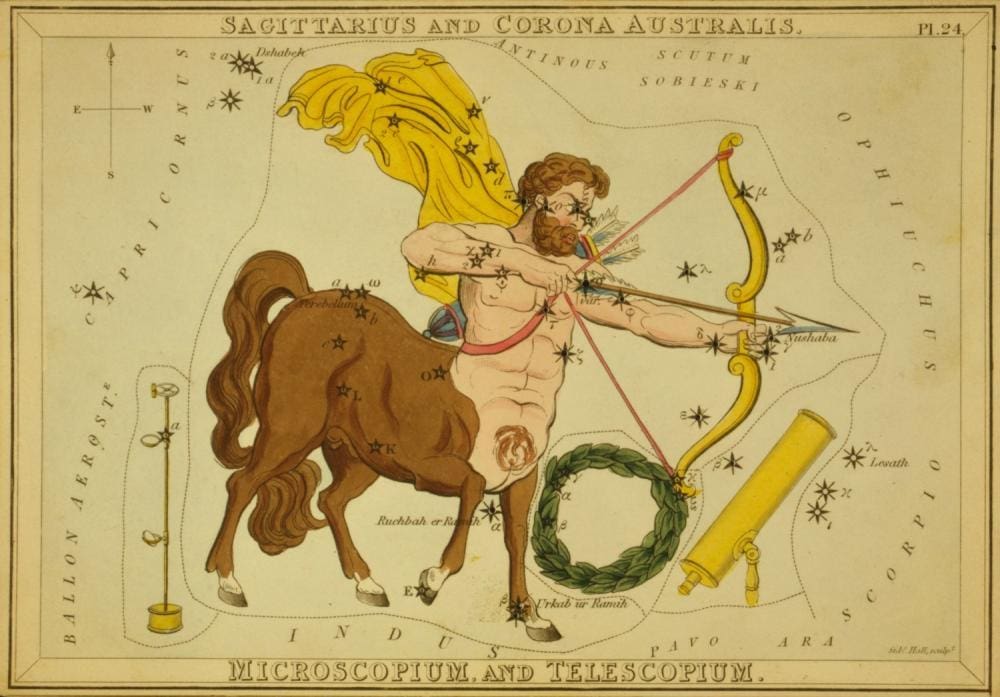
Sagittarius Constellation [Urania’s Mirror]
Sagittarius Constellation Astrology
Manilius (@ 35 AD)
The double Centaur different Tempers breeds,
They break the Horse, and tame the fiery Steeds;
They love the sounding Whip, the Race, the Rein,
And whirl the Chariot o’re the duty Plain;
Nor is their Humor to the Fields confin’d,
They range the Woods, and tame the Savage Kind;
Young Bears they break, and Tygers heats asswage,
And hear Young Lions roaring without Rage,
Discourse the Elephant, and Teach the Mass
A mimick Action, and a decent Grace;
To Act in Plays, or raise th’unwieldly load,
To Dance, and be the Darling of the Crowd.
For in the Frame, in double forms exprest,
The Man is uppermost, and rules the Beast;
His Bow full drawn implies, his Rays impart,
Strength to the Limbs, and Vigor to the Heart.
Quick active Motions, full of warmth and heat,
Still pressing on, unknowing to retreat. [13]
But they whose lot it is to be born under the Centaur of double form delight in yoking a team, in bringing a fiery horse to obey the pliant reins, in following herds which graze all over the grasslands, and in imposing a master on every kind of quadruped and taming them; they soften tigers, rid the lion of his fierceness, speak to the elephant and through speech adapt its huge bulk to human skills in a variety of displays. Indeed, in the stars of this constellation the human form is blended with a beast’s and placed above it; wherefore it has lordship over beasts. And because it carries a shaft poised on drawn bow, it imparts strength to limb and keenness to the intellect, swiftness of movement, and an indefatigable spirit. [14]
ASCENDING
Bold Sagittarius, when he first appears,
Heats the gay Birth, and makes him fam’d for Wars;
In Triumphs great, the Wonder of the Crowed,
By Captives carry’d, he almost a God
Shall climb the Capitol, bright Fame pursue,
Old Cities raze, or grace the Earth with New:
But ill success (his Forehead’s wreath’d with Frowns)
Shall wast his Fame, and blast his gather’d Crowns.
Thus Conquering Hannibal, by this Sign betray’d
Before his flight perceiv’d his Wreaths to fade,
He paid for Trebia’s and for Cannae’s fame,
And recompenc’d our Losses by his shame. [13]
As for the Archer, when the foremost portion of his cloak rises, he will give birth to hearts renowned in war and will conduct the conqueror, celebrating great triumphs in the sight of all, to his country’s citadels. Such a one will build high walls one moment and pull them down the next. But if Fortune favors them too generously with success, the mark of her envy is to be seen on their faces, for she works cruel havoc upon their features. So was it that a dread warrior [Hannibal, who lost an eye: Sagittarius is one-eyed] paid for his victories at the Trebia, Cannae, and the Lake, even before the hour of his retreat, with such disfigurement. [14]
Ptolemy (@150 AD)
Of the stars in Sagittarius, those in the point of his arrow have an effect like that of Mars and the moon; those in the bow and the grip of his hand, like that of Jupiter and Mars; the cluster in his forehead, like that of the sun and Mars; those in the cloak and his back, like that of Jupiter and, to a less degree, of Mercury; those in his feet, like that of Jupiter and Saturn; the quadrangle upon the tail, like that of Venus, to a less degree, of Saturn. [15]
Maternus (@335 AD)
I.24. Ascendant in Sagittarius. If the horoscope is found in Sagittarius, he will make many adversaries, and the accumulated patrimony will be given from where he had not expected. He will be frequently detained in foreign countries, he will sail a large river or a large sea. He will always be placed in public conversations, in watery places or from watery places he will have both life and fruit, he will acquire many arts and disciplines, he will be intelligent and knowledgeable in all things. If he is found in Virgo MC., he will be appointed to great promotions, and he will be preferred by many thanks to power . He will achieve the greatest power of license, and the crowd of his listeners will obey his commands, and many will have through him the support of life and livelihood, and to whomever he has bestowed anything of this kind, he himself will always be ungrateful.
25. If the setting is found in Gemini, and he has children He will also have grandchildren, but then when he has entered old age, and he will be such that he will bear all pains with the easiest of reasons, and who will despise losses with the authority of a right mind. Others will read secret letters and show the orders of heavenly or sacred things. They will be ingenious, just-hearted, and who will always pursue their adversaries with cunning dissimulations, teaching them everything and to whom happiness is conferred by slow processes. If he is in Pisces IMC., he will have the support of life in watery places. He will be such that everything is believed in his faith. He will be known and noble, but he will be alien to his wife or her affections . But if Jupiter has looked upon this place with some radiation, he will easily marry a wife, and his conjugal affections will be grateful to him, but he will marry a wife known to have committed adultery or fornication.
III.40. Saturn in Sagittarius. Whoever has Saturn in Sagittarius is involved in dangers and many illnesses, and does not obtain anything from their father’s or mother’s wealth. They will be in great losses and worries, and having obtained the greatest wealth by themselves, they will not receive this same wealth again they lose by miserable dissipation. They are involved in various illnesses and health conditions, and then they will have dangers throughout the whole span of their lives, when they come to the seven or the enneatical years.
41. But they are freed from these dangers by very easy reasons. But also when the square of generativity enters the places, that is, when it has entered the MC. or IMC. part, it will cause certain vanities in the mind, it will cause disturbances and domestic dissensions and inconveniences, it will cause losses, custody, causes losses, inconveniences, sadness. But when it is in Pisces, then it will give the beginnings of happiness, and when it makes a stop in the same sign, it decrees the insignia of life and glory, and bestows an increase in patrimony.
42. But when it comes to Gemini and Cancer, then it will be contrary to it in every way. When it comes to Sagittarius and Capricorn and Aquarius, it decrees disturbances and seditions. When he comes to Pisces for the second time, he will make them famous again, and they will gain all that they have lost, with a great increase in their wealth.
43. But those who have Saturn thus in the horoscope never get virgin wives, and always get three wives, and they will always have constant sorrows from the misfortunes of their children. But if Jupiter, placed in Sagittarius, does not reflect any radiation on Saturn, he will neither give wives nor children. He will certainly have serious sorrows because of a woman or for the sake of a woman, and in water or near water they will incur serious dangers in life.
IV.21. Jupiter in Sagittarius. Whoever has Jupiter in Sagittarius will be glorious, powerful, noble, well-known, powerful leaders or friends of leaders or powerful people, wealthy, abundant, learned. But whatever they have achieved they will lose as long as the first place of the birth of Saturn has passed. For then they will be in turmoil, in sorrows, in seditions, and whatever they wish to accomplish will not have prosperous results..
22. But they will be in these times in distress and in labor, as long as Jupiter, having completed the second circle of his course, has agreed to his place with a prosperous radiation. For then he gradually decrees all prosperity according to the power of the places, then he bestows knowledge, then glory, then power, then authority, then increases in patrimony, then he will give cheerfulness, then joy, then he decrees marriages and children. But those who have Jupiter in this way will possess the patrimony of others. They will certainly be good and fit for everything. The duty of humanity.
23. In the first period of their life they will be stable in all things and will disagree with their wives. But those who are placed in the middle of their life will rejoice in prosperous happiness. But if in their natal Saturn Jupiter placed in Sagittarius is struck by either a square or a diameter radiation, they will either have no wives or children, especially if Jupiter is found in the limits of Saturn. They will be men of great fortune, liberal, lovable, friends of many, known to all, honest, adorned with every kind of goodness, especially if placed in the first places of their natal birth it reflects any other star with a trine radiation. [16]
Allen (1889)
Sagittarius, the Archer,
The formation of this constellation on the Euphrates undoubtedly preceded that of the larger figure, the Centaur Chiron (the constellation Centaurus); but the first recorded classic figuring was in Eratosthenes’ description of it as a Satyr, probably derived from the characteristics of the original Centaur, Hea-bani (Heabani), and it so appeared on the more recent Farnese globe. But Manilius mentioned it, as in our modern style, mixtus equo, and with threatening look, very different from the mild aspect of the educated Chiron, the Centaur of the South (Centaurus); while it sometimes is given in later manuscripts and maps with flowing robes; but his crown (the constellation Corona Australis) always appears near his fore feet, and his arrow is always aimed at the Scorpion’s heart.
We have already noticed the confusion in the myths and titles of this zodiacal Centaur with those of the southern Centaur (the constellation Centaurus), some thinking Sagittarius the Χείρων of the Greeks, — Chiron with Hyginus and the Romans; although Eratosthenes and others, as did the modern Ideler, understood this name to refer to the Centaur proper.
Early tradition made the earthly Chiron the inventor of the Archer constellation to guide the Argonauts in their expedition to Colchis; although, and about as reasonably, Pliny said that Cleostratos originated it, with Aries, during the 6th or 5th century B.C. As to this we may consider that, while Cleostratos, possibly, was the first to write on it, certainly none of the Greeks gave it form or title, for we see abundant evidence of its much greater antiquity on the Euphrates.
Cuneiform inscriptions designate Sagittarius as the Strong One, the Giant King of War, and as the Illuminator of the Great City, personifying the archer god of war, Nērgal or Nērigal, or under his guardianship, as the Great Lord. This divinity is mentioned in the Second Book of Kings, xvii.30. An inscription, on a fragment of a planisphere, transcribed by Sayce as Utucagaba, “the Light of the White Face,” and by Pinches as Udgudua, “the Flowing (?) Day,” or “the Smiting Sun Face,” is supposed to be an allusion to this constellation; while on this fragment also appear the words Nibat Anu, which accord with an astrolabe of Sennacherib, and were considered by George Smith as the name of its chief star. Another inscribed tablet, although somewhat imperfect, is thought to read Kakkab Kastu, “the Constellation, or Star, of the Bow,” — in Akkadian Ban, — indicating one or more of the bow stars of the Archer. This will account for the Τόξον of Aratos and the Arcus of the Latins, Sayce agreeing with this in his rendering of Mulban as “the Star of the Bow.” Pa and χut, “Dayspring,” also seem to have been titles, the latter because our Archer was a type of the rising sun. Upon some of the boundary stones of Sippara (Sepharvaim of the Old Testament), a solar city, Sagittarius, “appears sculptured in full glory.” From all the foregoing it would seem safe to assume the Archer to be of Euphratean origin.
In ancient Arabia the two small groups of stars now marking the head and the vane of the Archer’s arrow were of much note as relics of still earlier asterisms, as well as a lunar station. The westernmost of these, — γ, δ, ε, and η — were Al Naʽām al Wārid, “the Going Ostriches;” and the easternmost, — σ, ζ, φ, χ, and τ, — Al Naʽām al Ṣādirah, “the Returning Ostriches,” passing to and from the celestial river, the Milky Way, with the star λ for their Keeper. All of the foregoing stars, with μ¹ and μ², were included in the 18th manzil, Al Naʽām.
The 19th manzil lay in the vacant space from the upper part of the figure toward the horns of the Sea-Goat, and was known as Al Baldah, “the City, or District,” for this region is comparatively untenanted. It was marked by one scarcely distinguishable star, probably π, and was bounded by six others in the form of a Bow, the Arabs’ Ḳaus, which, however, was not our Bow of Sagittarius. It also was Al Kilādah, “the Necklace;” and Al Udḥiyy, “the Ostrich’s Nest,” marked by our τ, ν, ψ, ω, A, and ζ; while the space between this and the preceding mansions was designated by Al Bīrūnī as “the head of Sagittarius and his two locks.” In his discussion of this subject, quoting, as he often did, from Arab poets, he compared this 19th manzil to “the interstice between the two eyebrows which are not connected with each other,” — a condition described by the word ᾽Ablad, somewhat similar to the Baldah generally applied to it.
The 18th sieu, Ki, “a Sieve,” anciently Kit, was the first of these groups; and the 19th, Tew, Tow, or Nan Tow, “a Ladle or Measure,” anciently Dew, was the second; both being alluded to in the She King:
In the south is the Sieve
Idly showing its mouth
But it is of no use to sift;
the commentator explaining that the two stars widest apart were the Mouth, and the two closer together the Heels; but he does not give the connection of these with the Sieve. And of the second group:
In the north is the Ladle
Raising its handle to the west
But it lades out no liquor;
so that our Milk Dipper, ζ, τ, σ, φ, and λ, in the same spot, is not a modern conceit after all. The stars of this Ladle were objects of special worship in China for at least a thousand years before our era; indeed, also were known as a Temple.
Astrologically the constellation was the House of Jupiter, that planet having appeared here at the Creation, although this honor was shared by Aquarius and Leo. Nor did Jupiter monopolize its possession, for it also was the domicile of Diana, one of whose temples was at Stymphalus, the home of the Stymphalian birds. These last, when slain by Hercules, were transferred to the sky as Aquila, Cygnus, and Vultur Cadens (Lyra), and are all paranatellons of Sagittarius, as has been explained under Aquila. Thus the constellation was known as Dianae Sidus. It inclined to fruitfulness, a character assigned to it as far back as the Babylonian inscriptions; and was a fortunate sign, reigning over Arabia Felix, Hungary, Liguria, Moravia, and Spain, and the cities of Avignon, Cologne, and Narbonne; while Manilius said that it ruled Crete, Latium, and Trinacria. Ampelius associated it with the south wind, Auster, and the southwest wind, Africus; Aries and Scorpio being also associated with the latter. Yellow was the color attributed to it, or the peculiar green sanguine; and Arcandum in 1542 wrote that a man born under this sign would be thrice wedded, very fond of vegetables, would become a matchless tailor, and have three special illnesses, the last at eighty years of age. Such was much of the science of his day! [3]
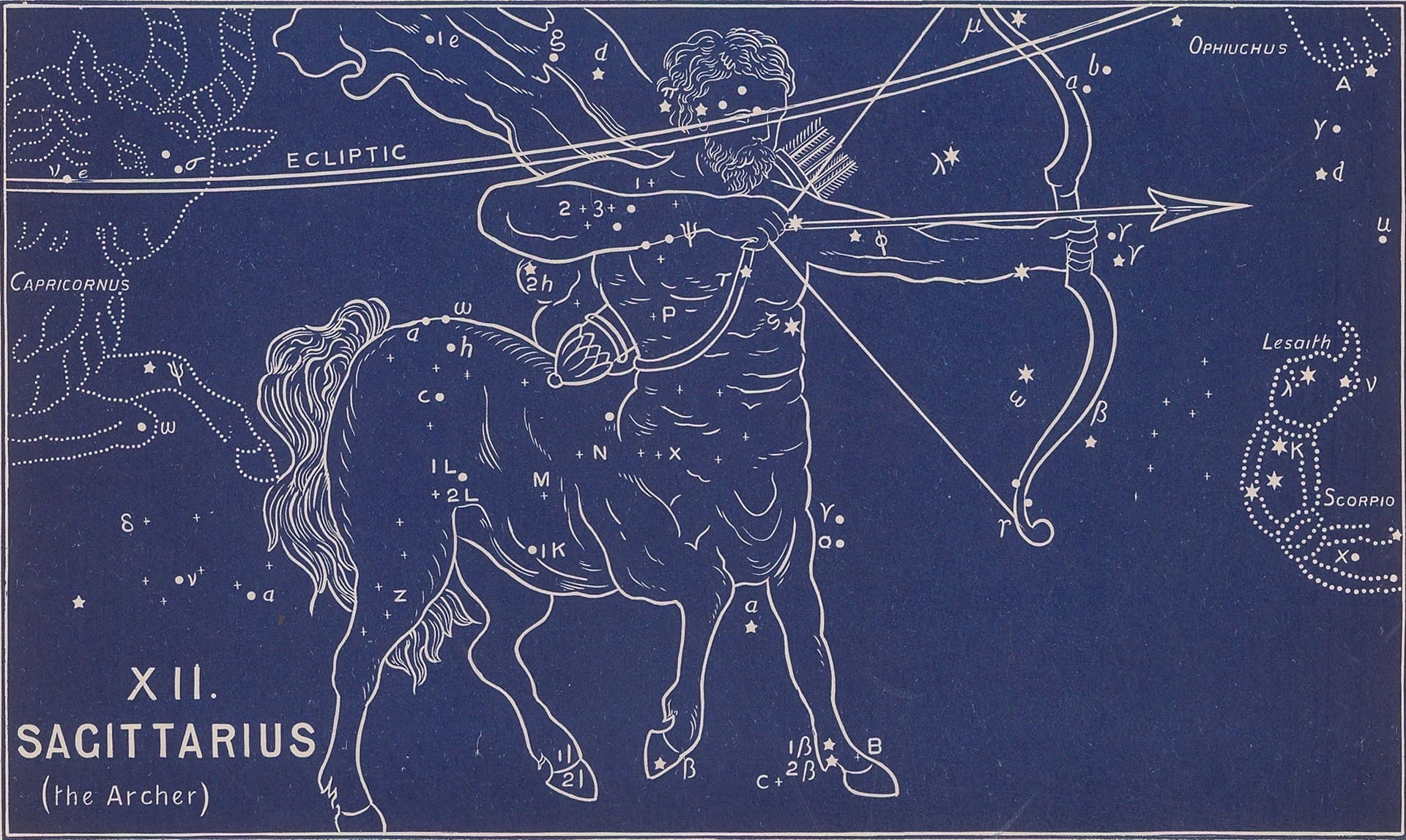
Sagittarius Constellation [Bullinger]
Bullinger (1893)
The Sign SAGITTARIUS.
This is the concluding chapter of the first great book of this Heavenly Revelation; and it is occupied wholly with the triumph of the Coming One, who is represented as going forth “conquering and to conquer.”…This is precisely what is foreshadowed in the star-pictured sign now called by the modern Latin name Sagittarius, which means the Archer. The Hebrew and Syriac name of the sign is Kesith, which means the Archer (as in Genesis 21:20). The Arabic name is Al Kaus, the arrow. In Coptic it is Pimacre, the graciousness, or beauty of the coming forth. In Greek it is Toxotes, the archer, and in Latin Sagittarius.
There are 69 stars in the sign, viz., five of the 3rd magnitude (all in the bow), nine of the 4th, etc…An ancient Akkadian name in the sign is Nun-ki, which means Prince of the Earth. Again we have the picture of a Centaur as to his outward form, i.e. a being with two natures. Not now far down in the south, or connected with His sufferings and sacrifice as man; but high up, as a sign of the Zodiac itself, on the ecliptic, i.e. in the very path in which the sun “rejoiceth in his going forth as a strong man.” According to Grecian fable, this Sagittarius is Cheiron, the chief Centaur; noble in character, righteous in his dealings, divine in his power…
In the ancient Zodiac of Denderah he is called (as in Coptic) Pi-maere, i.e. graciousness, beauty of the appearing or coming forth. The characters under the hind foot read Knem, which means He conquers…In all the pictures he is similarly represented, and the arrow in his bow is aimed directly at the heart of the Scorpion. [17]
Robson (1923)
SAGITTARIUS. The Archer.
Legend. This constellation represents the wise and just Centaur Chiron, who was killed by accidentally dropping one of the poisoned arrows of Hercules upon his foot.
Influence. The following are Ptolemy’s remarks: “The stars at the point of the arrow in Sagittarius have influence similar to that of Mars and the Moon: those on the bow, and at the grasp of the hand, act like Jupiter and Mars . . . those in the waist and in the back resemble Jupiter, and also Mercury moderately: those in the feet, Jupiter and Saturn.” … By the Kabalists Sagittarius is associated with the Hebrew letter Vau and the 6th Tarot Trump “The Lovers.” [18]
Rigor (1979)
LEO: Symbolized by the Centaur, a horse’s body with a man’s head and an arm holding a bow and arrow.
MYTHOLOGY: The famous Centaur, Chiron, son of Philyra and Saturn, changed himself into a horse to elude his jealous wife, Rhea. Chiron was slain by Hercules with a poisoned arrow, and realizing the wound was incurable, he entreated Jupiter, the father of gods, to deprive him of his immortality. Jupiter granted him his request and placed him amongst the constellations in the heavens. Hercules, who personified the Sun-god, pierced Chiron with his arrow and rather than request Jupiter to deprive him of his immortality, he begged him to deprive him of his mortality. The father of gods granted him his request and immortalized him amongst the constellations in the heavens. In the Old Testament, Genesis, 49th Chapter, Jacob lectures to his twelve sons. Sagittarius is the sign symbolizing travel and the tribe of Gad from whence the term ‘gadding about’ comes. As it rules the higher mind, and true religious conception, regardless of what may overcome the Sagittarian, true spiritual understanding shall overcome all at last. Rhea, in the myth, symbolizes the opposite of Sagittarius, which is Gemini, the lower mind. Rhea is the renegade goddess and in order to evade the lower mind, Chiron changed himself into a horse, Sagittarius.
SAGITTARIANS: are generally endowed with a hopeful disposition and at times has strong religious tendencies. Sagittarians cannot bear to be hampered. Their inclination is to be very active in promoting any cause they espouse. They have a tendency to be abrupt, but not with the intention of causing suffering, for as a rule, Sagittarians are generous. A love of outdoor life, a fondness for animals and a somewhat prophetic spirit are latent with Sagittarians. There can be a natural inclination to associate with others whom they will influence. Religion and philosophy appeal to Sagittarians. The Sagittarian is not prone to follow conventional lines of thought, but is ever-seeking to express their own individuality. Domestic affairs may be chaotic and unsettled. They tend to be impulsive. However, they do possess good analytical minds and generally do not jump to conclusions.
Negatively; Sagittarians engage in inconsiderate behavior and can be very tactless at times, but whenever their emotions are involved they can become very talkative and exaggerate. They can be both rude and crude, having the knack of saying that one last word – that offends. Their exuberance leads to extravagance and carelessness over details. They tend to give the impression that they are very knowledgeable. They can have many prejudices.
KEYWORDS for the Sagittarius constellation:
(+) Positive: Sympathetic, just, independent, generous, fairness, righteous, prophetic.
(–) Negative: Combative, indecisive, impressionable, superficial, unreliable, impulsive, brusque.
SUN IN SAGITTARIUS (+) Endows its natives with the highest integrity and morals. Their talents and aptitudes may be widely varied. Their nature is dignified, and of good temperament, frank and with a buoyance that can be quite catching. Native has a tendency to become ambitious, speculative. One who is outspoken, with an understanding of both philosophy and of religion. A refined person, one who dislikes sordid actions and anything coarse or sensual. One with lofty ideals, of a benevolent philanthropic disposition and with an expansive mind. One with liberal ideas.
SUN IN SAGITTARIUS (–) The native may be too sporty, boastful, and lazy. Inconsiderate of others, exaggerating and garrulous. One who promises more than they can deliver. The native may be ‘rude and crude’ on occasion and develop the knack of saying the one last Cutting remark. Exuberance leading to extravagance. One who is careless over details, may become an exhibitionist, subject to short-lived enthusiasm; one with many prejudices, even intense likes and dislikes. An extremist and tactless person. One who is boisterous.
MOON IN SAGITTARIUS (+) Endows its natives with an alert, active nature. One who is good-humored, optimistic. Has a humanitarian nature and viewpoints. Grandly liberal. Has reverend emotions. Dislikes sordid actions. A philosophical nature, frank with a high-minded attitude. Native has strong attachments to religious or philosophical beliefs. Sometimes quick to anger, but generally of a forgiving nature. The native develops highest morals and integrity.
MOON IN SAGITTARIUS (–) Native prefers ‘ease,’ has good intentions, despairs of achievement. Has strong sectarian or philosophical views. Is careless, reckless. Tendency to escape reality. Sets unattainable goals for themselves. Impractical goals.
MERCURY IN SAGITTARIUS (+) Endows its natives with eloquence, frankness, oratorical ability. A jovial buoyant personality. Native is ambitious, independent, sincere, law-abiding, noble and of a religious or philosophical mind. Native dislikes shackles of normal conventions when they interfere with freedom of thought. Native is progressive, mentally alert, authoritive, somewhat prophetic.
MERCURY IN SAGITTARIUS (–) Native may be officious, of a restless closed mind. A demanding type person, one who may be objectionable. Lacks concentration powers, might be inclined to lawlessness, entertain ‘twisted’ ideas, of an impractical nature. Dishonest.
VENUS IN SAGITTARIUS (+) Endows its natives with a degree of impulsiveness and inconstancy. The native may develop a fruitful imagination, be intuitive, of goodwill, and of a genial and optimistic disposition. Native may be prophetic and of loyal intentions. Possibly an attraction for philosophy and religion.
VENUS IN SAGITTARIUS (–) Native may be carefree with finances, a love of too much freedom. Native may become insincere, too daring. A superficial individual, not altogether of a constant nature. Jealousy.
MARS IN SAGITTARIUS (+) Endows its natives with an enthusiastic ambition. Native can generate enthusiasm, is free and frank in all their dealings. Has an active mentality; morally and mentally open and brave. Native may develop a fondness for debate and have a speculative and venturesome nature. One with a buoyant and independent attitude. A fondness for outdoor activities. Fearless of opinion of others.
MARS IN SAGITTARIUS (–) One with impractical ideas, an exaggeration difficult to control. Impractical ideas, a quarrelsome disposition. Native overestimates their capabilities. Always at variance with ideas and opinions of others. Philosophically or religiously skeptical. [19]
Noonan (1984)
Cuneiform inscriptions designate Sagittarius as the “Strong One,” the “Giant King of War,” and as the “Illuminator of the Great City,” personifying the archer god of war, Negrel of 4 Kings, xvii: 30. Early tradition had the constellation put into the sky so that the Archer could guide the argonauts in their expedition to Colchis. Like Aries, Sagittarius promises a variety of indications. Manilius put it: “The double centaur different tempers breed.” The sign is the principal house of Jupiter; however, it was also the domicile of the goddess Diana, one of whose temples was at Stymphalus, the home of the Stymphalian birds. When these birds were slain by Hercules, they were transferred to the sky as the paranatellons of Sagittarius: the stars Aquila, Cygnus, and Vultur Cadens.
Sagittarius is a fortunate sign. Those born under it will be jovial, strong, and generous. Ibn Ezra says that they will be agile in jumping, fond of horses, a geometer, will have a weak voice and few children. A 12th-century astrologer wrote that a man born under this sign would be thrice wedded, very fond of vegetables, would become a matchless tailor, and have three special illnesses (the last at eighty years of age). Our medieval sage may have been a bit far out, but Ibn Ezra was correct as to the number of children. From antiquity, Sagittarius presages a great desire for marriage, but small families.
In appearance, the Sagittarian will be tall and good-looking, especially from the back view. He will be of light, even red, complexion. He will have good eyes, a large belly, and his shanks will be longer than his thighs. In classical times, a long beard, coarse nose, and marks on the arms and legs were usually added. Modern astrologers assert dignity or carriage and a high, dome-shaped forehead.
Those born under the sign of Sagittarius will be a capable matherm,atician, thoughtful about the next world, fond of horses, and a particular food, drink, and clothing. He will be kingly, virile, reticent, liberal, and on the bad side tricky and prejudiced. Those born in the first decanate will uphold all that is good, and accordinf to ibn Ezra, will associate with kings and magistrates, those born under the third decanate modest, helpful, and well-bred.
Modern astrologers assert that those born under this sign will be sympathetic, just, intelligent and a deep thinker. He will also be impulsive and may have a temper. There is also a tendency for the native to be brusque and boisterous, and as a result, is likely to be misunderstood.
The professions of the Sagittarius are surveyors, horse dealers, and, according to al-Biruni, middle-class people and busy-bodies or meddlers in other people’s business who excite strife (albeit with honest intentions). Modern astrologers add lawyers, horse trainers, jockeys, ministers, philosophers, publishers, and sportsmen. [20]
Noonan (1990)
The Constellation of the Archer.
Now called Sagittarius (Sgr), this constellation is the Domicile of Diana and in classical times was also known as Diannae Sidus. It is a fortunate and fruitful constellation indicating events pertaining to kings or a large portion of mankind. Ptolemy states:[14]“…the stars in the point of the arrow have an effect like that of the Moon and Mars; those in the bow and the grip of the hand like that of Jupiter and Mars; the cluster in the forehead like that of the Sun and Mars; those in the cloak and the back like Jupiter, and to a lesser dgree like Mercury; the stars in the feet have a nature akin to that of Jupiter and Saturn; and the quadrangle upon the tail like Venus, and to a lesser degree like Saturn.” [21]
References
-
- SkyEye: (Un)Common Star Names – Official Names.
- A Dictionary of Modern Star Names, Kunitzch, Smart, 2006, p.51.
- Star Names: Their Lore and Meaning, Richard H. Allen, 1889, p.351-360.
- Sagittarius in Chinese astronomy – Wikipedia.
- List of stars in Sagittarius – Wikipedia
- On a Catalogue of Stars in the Calendarium of Mohammad Al Achasi Al Mouakket, E. B. Knobel, 1895, p.430-435.
- SkyEye: (Un)Common Star Names – Alternative Names.
- Eta Sagittarii – Indonesian Wikipedia.
- eSky: Sephdar.
- Technical Memorandum 33-507-A Reduced Star Catalog Containing 537 Named Stars, Jack W. Rhoads, 1971.
- Tau Sagittarii, fr-academic.com.
- Sagittarius (constellation) – Italian Wikipedia.
- Astronomica, Manilius, 1st century AD, Book 4, X, p.14, 27. (Creech, 1700).
- Astronomica, Manilius, 1st century AD, book 4, pp. 239-241, 267. (Goold, 1977).
- Tetrabiblos, Ptolemy, 2nd century AD, Book 1, Chapter 9.
- Mathesis, Firmicus Maternus. @335 AD, Book 5, pp.13-14, 42-43, 56-57.
- The Witness of the Stars, E. W. Bullinger, 1893, 12. Sagittarius (the Archer).
- Fixed Stars and Constellations in Astrology, Vivian E. Robson, 1923, p.60.
- The Power of the Fixed Stars, Joseph E. Rigor, 1979, p.163-64, 318-319, 323-324, 328, 333, 337-337.
- Classical Scientific Astrology, George Noonan, 1984, p.75-77.
- Fixed Stars and Judicial Astrology, George Noonan, 1990, p.49.