
STARS: Major | All | Constellations | Chinese | About
18♉02 to 00♋12
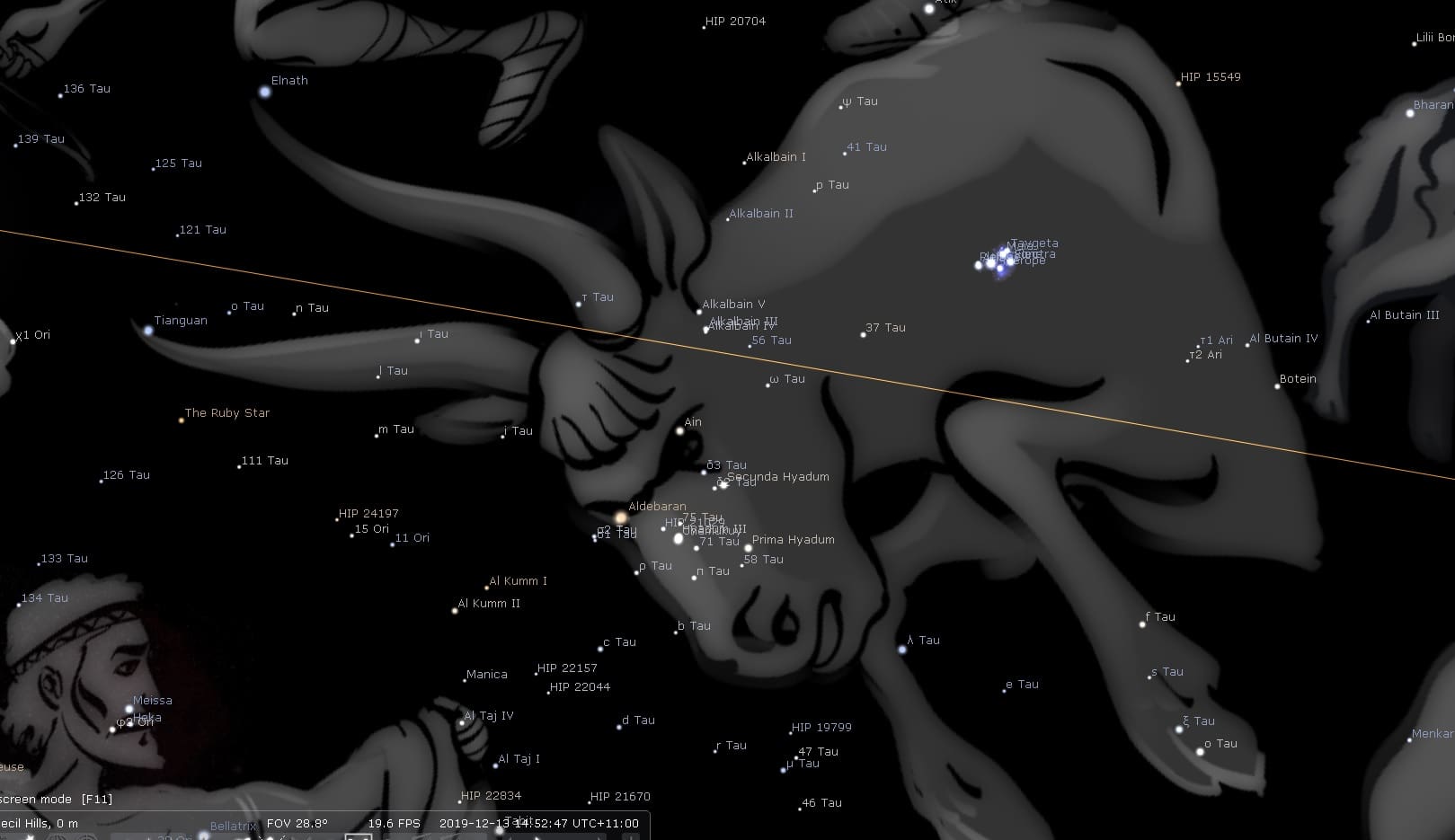
Taurus Constellation [Stellarium]
Taurus is one of the 48 constellations listed by Ptolemy in the 2nd century and remains one of the 88 modern constellations. It spans 30 degrees of the zodiac in the Signs of Taurus and Gemini.
Abbreviation: Tau
Genitive: Tauri
Taurus Constellation Stars
| 2000 | 2050 | Star | Name | Spec. | Mag. | Orb |
|---|---|---|---|---|---|---|
| 21♉10 | 21♉52 | ο Tau | Atirsagne | G6 | 3.61 | 1°40′ |
| 21♉55 | 22♉37 | ξ Tau | Ushakaron | B9 | 3.73 | 1°30′ |
| 21♉57 | 22♉39 | 10 Tau | F9 | 4.29 | 1°20′ | |
| 23♉36 | 24♉18 | f Tau | Berhan Esat | K0 | 4.14 | 1°20′ |
| 29♉25 | 00♊07 | 17 Tau | Electra | B6 | 3.72 | 1°30′ |
| 29♉26 | 00♊09 | 16 Tau | Celaeno | B7 | 5.45 | 1°00′ |
| 29♉34 | 00♊16 | 19 Tau | Taygeta | B6 | 4.30 | 1°10′ |
| 29♉41 | 00♊23 | 20 Tau | Maia | B8 | 3.87 | 1°30′ |
| 29♉42 | 00♊24 | 23 Tau | Merope | B6 | 4.14 | 1°20′ |
| 29♉45 | 00♊27 | 21 Tau | Asterope | B8 | 5.76 | 1°00′ |
| 29♉55 | 00♊38 | ν Tau | Furibundus | A1 | 3.91 | 1°30′ |
| 00♊00 | 00♊42 | η Tau | Alcyone | B7 | 2.85 | 2°00′ |
| 00♊22 | 01♊04 | 27 Tau | Atlas | B8 | 3.62 | 1°40′ |
| 00♊23 | 01♊05 | 28 Tau | Pleione | B8 | 5.05 | 1°00′ |
| 00♊38 | 01♊21 | λ Tau | Bibing | B4 | 3.41 | 1°40′ |
| 03♊28 | 04♊10 | 37 Tau | Yue | K0 | 4.36 | 1°10′ |
| 03♊35 | 04♊17 | μ Tau | Kattupothu | B3 | 4.27 | 1°20′ |
| 05♊35 | 06♊17 | 57 Tau | Tianjiésan | F3 | 5.58 | 1°00′ |
| 05♊45 | 06♊28 | 66 Tau | Tianjiéba | A3 | 5.10 | 1°00′ |
| 05♊49 | 06♊31 | γ Tau | Hyadum I | G8 | 3.65 | 1°40′ |
| 06♊04 | 06♊46 | ω² Tau | Tianjiēer | A3 | 4.93 | 1°00′ |
| 06♊53 | 07♊35 | δ¹ Tau | Hyadum II | G8 | 3.77 | 1°30′ |
| 07♊17 | 08♊00 | π Tau | Tianjiéyi | G8 | 4.69 | 1°00′ |
| 07♊22 | 08♊05 | 71 Tau | Polyxo | F0 | 4.48 | 1°10′ |
| 07♊32 | 08♊15 | δ³ Tau | Bisuer | A2 | 4.30 | 1°10′ |
| 07♊34 | 08♊16 | 79 Tau | Tianjiési | A7 | 5.02 | 1°00′ |
| 07♊55 | 09♊37 | φ Tau | Alkalbain I | K1 | 4.97 | 1°00′ |
| 07♊58 | 08♊40 | θ¹ Tau | Hyadum III | G9 | 3.84 | 1°30′ |
| 07♊58 | 08♊40 | θ² Tau | Hyadum IV | A7 | 3.40 | 1°40′ |
| 08♊07 | 08♊49 | ε Tau | Ain | K0 | 3.53 | 1°40′ |
| 08♊12 | 08♊55 | κ² Tau | Alkalbain III | A7 | 5.27 | 1°00′ |
| 08♊13 | 08♊55 | κ¹ Tau | Alkalbain IV | A7 | 4.21 | 1°20′ |
| 08♊28 | 09♊10 | χ Tau | Alkalbain II | B9 | 5.38 | 1°00′ |
| 08♊30 | 09♊13 | υ Tau | Alkalbain V | A8 | 4.28 | 1°20′ |
| 08♊48 | 09♊30 | 88 Tau | Tianjiéqi | A5 | 4.25 | 1°20′ |
| 09♊03 | 09♊46 | ρ Tau | Tianjiéer | A8 | 4.65 | 1°00′ |
| 09♊46 | 20♊28 | 90 Tau | Tianjiéwu | A6 | 4.27 | 1°20′ |
| 09♊48 | 10♊30 | α Tau | Aldebaran | K5 | 0.87 | 2°40′ |
| 10♊11 | 10♊53 | 93 Tau | Tianjiéliu | B8 | 5.45 | 1°00′ |
| 10♊31 | 11♊13 | σ² Tau | Fuer | A5 | 4.67 | 1°00′ |
| 12♊09 | 12♊52 | τ Tau | Huágàizhōngyāngdàxīn | B3 | 4.27 | 1°20′ |
| 22♊35 | 23♊17 | β Tau | El Nath | B7 | 1.65 | 2°20′ |
| 23♊24 | 24♊06 | 119 Tau | Ruby Star | M2 | 4.32 | 1°10′ |
| 24♊47 | 25♊30 | ζ Tau | Al Hecka | B1 | 2.97 | 1°50′ |
| 29♊33 | 00♋15 | 139 Tau | Sīguàiyī | B1 | 4.81 | 1°00′ |
Taurus Star Names
10 Tauri belonged to the obsolete constellation Psalterium Georgii.
α Tau is officially named Aldebaran, meaning “the Follower.”
β Tau is officially named Elnath, meaning “the Butting (with the horns).”
ζ Tau is officially named Tianguan, meaning “Celestial Gate.” Astrologers call it Al Hecka.
The Hyades, “rain-makers.”
In Greek mythology, the Hyades were daughters of Atlas and Aethra, and hence half-sisters of the Pleiades. [3]
- γ Tau Ambrosia, “immortality”
- δ¹ Tau Eudora, “generous”
- δ³ Tau Kleea, “famous”
- ε Tau Koronis, “crow”
- θ¹ Tau Phaeo, “dim”
- θ² Tau Phaesula, “filtered light”
- 71 Tau Polyxo, “many”
γ Tau is officially named Prima Hyadum, traditionally Hyadum I, Latin for “First of the Hyades”.
γ Tau is also named Ambrosia, [4] meaning “immortality,” the ancient name of one of the seven Hyades listed by Pherecydes. [3]
δ¹ Tau is officially named Secunda Hyadum, traditionally Hyadum II, Latin for “Second of the Hyades”.
δ¹ Tau is also named Eudora [4] meaning “generous,” the name of one of the five Hyades listed by Hesiod. [3]
δ³ Tau is traditionally named Cleeia (Latin) or Kleea (Greek), meaning “famous,” the name of one of the five Hyades listed by Hesiod. [3]
ε Tau is officially named Ain. From an abbreviation of the modern Arabic name, ʽain al-thaur “the Bull’s Eye,” for α Tau. Applied to ε Tau in recent times (Ptolemy had α Tau on the southern eye, and ε Tau on the northern eye). [1]
ε Tau is also named Coronis (Latin) or Koronis (Greek), meaning “crow”, the ancient name of one of the seven Hyades listed by Pherecydes. Flamsteed called it Oculus boreus, “the Northern Eye”. [3]
θ¹ Tau is officially named Chamukuy, after a small bird in Mayan mythology. [5]
θ¹ Tau is also named Phaeo, meaning “dim,” the name of one of the five Hyades listed by Hesiod. [3]
θ¹ Tau is astrologically named Hyadum III, Latin for “Third of the Hyades”.
θ² Tau is named Phaesula (Latin), Phaesyle or Aesyle (Greek), meaning “filtered light,” the name of one of the five Hyades listed by Hesiod. [3]
θ² Tau is astrologically named Hyadum IV, Latin for “Fourth of the Hyades”.
71 Tau is named Polyxo, [4] meaning “many”, the ancient name of one of the seven Hyades listed by Pherecydes. [3]
The Pleiades, “daughters of Pleione”
In Greek mythology, the Pleiades were the seven daughters of Atlas and Pleione, and hence half-sisters of the Hyades. [3]
These official and traditional names were individually applied in Renaissance times from a family of characters in Greek mythology: Atlas, Pleione, and their seven daughters, the Pleiades. [1]
- η Tau Alycone, “kingfisher”
- 16 Tau Celaeno, “black”
- 17 Tau Electra, “amber, shining, bright”
- 19 Tau Taygeta, “long-necked”
- 20 Tau Maia, “mother”
- 21 Tau Sterope, “lightning”
- 23 Tau Merope, “with face turned”
- 27 Tau Atlas, “hard, enduring”
- 28 Tau Pleione, “to increase in number”
κ¹ Tau is named Alkalbain III, from the Arabic Al Kalbain, “the Two Dogs.” [6]
κ² Tau is named Alkalbain IV, from the Arabic Al Kalbain, “the Two Dogs.” [6]
λ Tau is named Althaur, [4] or Sadr Al Thaur, from the Arabic صدر الثور Ṣadr al-Ṯawr , “the Breast of the Bull”, [7] or Sadr al Tauri, which was translated into Latin as Pectus Tauri, meaning “the bull chest” [8]
μ Tau is named Kattupothu [4] KāttuPōththŭ (കാട്ടുപോത്ത്), means “Wild Bull” in Malayalam [9]
ν Tau is named Furibundus, meaning “furious” in Latin and coming from Taurus Furibundus, “the furious bull”. [10]
ξ Tau is named Ushakaron [4] or Yshakaron, from the Akkadian names meaning “Exacter of Justice and Retribution” or “The Avenger” or “The Vindicator”. [11]
ο Tau is named Atirsagne, [4] an Akkadian name meaning “the green sign” or “The sign of greenness”, referring to the ancient Babylonian belief that the Sun crosses the constellation Taurus (Akkadian Alap-same “celestial bull”) in the middle of the spring, when the vegetation and flora are renewed by new foliage. [12]
σ² Tau is named Fuer, from the traditional Chinese name Fùěr (附耳), “Whisper.” [2]
τ Tau has the traditional Chinese name Huágàizhōngyāngdàxīng (華蓋中央大星), “Big star in the center of Canopy of the Emperor.” [2]
υ Tau is named Alkalbain V, from the Arabic Al Kalbain, “the Two Dogs.” [6]
φ Tau is named Alkalbain I, from the Arabic Al Kalbain, “the Two Dogs.” [6]
χ Tau is named Alkalbain II, from the Arabic Al Kalbain, “the Two Dogs.” [6]
f Tau is named Berhan Esat or Birhan Isat, meaning “Light of Fire” in Ge’ez, or simply Berhan, “Light” or Esat, “Fire”. The name is said to be a truncation from the Ge’ez phrase Birhan Isat Igziabher, “Light of Divine Fire.” [13]
37 Tau has the traditional Chinese name Yuè (月), meaning “Moon.” [2]
139 Tau has the traditional Chinese name Sīguàiyī ( 司怪一), “1st star of Deity in Charge of Monsters.” [2]
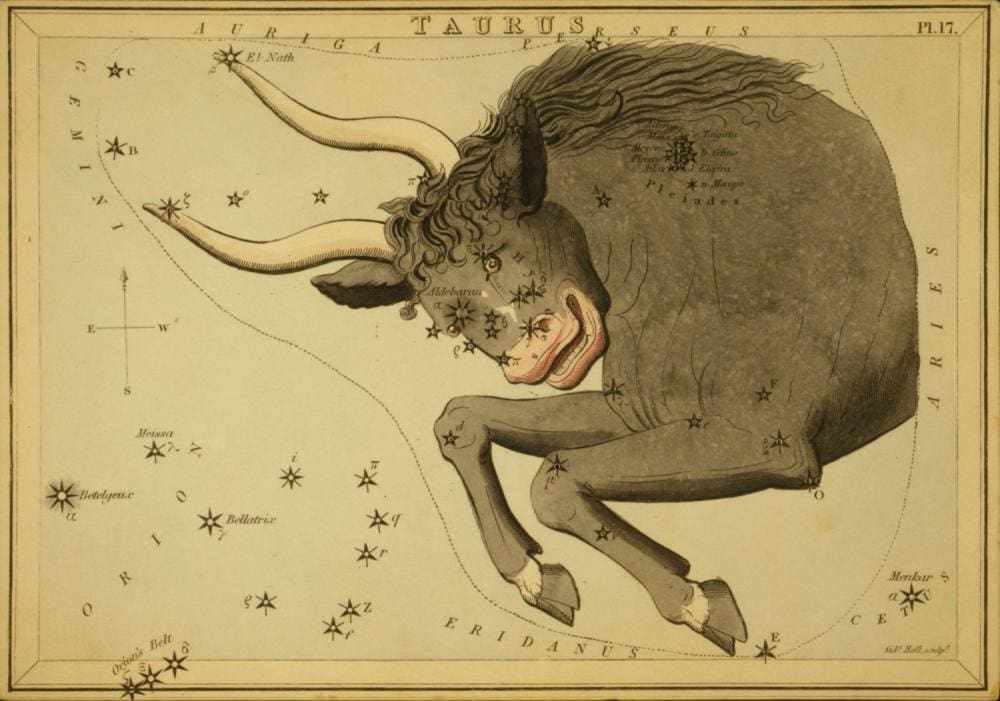
Taurus Constellation [Urania’s Mirror]
Taurus Constellation Astrology
Manilius (@35 AD)
Dull Honest Plowmen to manure the Field
Strong Taurus bears, by him the Grounds are till’d:
No gaudy things he breeds, no Prize for worth,
But Blesseth Earth, and brings her Labour forth:
He takes the Yoke, nor doth the Plough disdain,
And teacheth Farmers to manure the Plain:
He’s their Example, when he bears the Sun
In his bright Horns, the noble toyl’s begun:
The useful Plowshare he retrieves from Rust,
Nor liest at ease, and wants his strength in Dust
To him the Curij, and to him we owe
The brave Serrani, he i’the’Fields did Rods bestow,
And sent a Dictator from his Plow.
Reserv’d, aspiring Minds, Limbs slow to move
But strong in Bulk his powerful Rays improve,
And on his Curled Front fits wanton Love. [14]
The Bull will dower the countryside with honest farmers and will come as a source of toil into their peaceful lives; it will bestow, not gifts of glory, but the fruits of the earth. It bows its neck amid the stars and of itself demands a yoke for its shoulders. When it carries the sun’s orb on its horns, it bids battle with the soil begin and rouses the fallow land to its former cultivation, itself leading the work, for it neither pauses in the furrows nor relaxes its breast in the dust. The sign of the Bull has produced a Serranus [Gaius Atilius Regulus Serranus] and a Curius [Manius Curius Dentatus], has carried the rods of office through the fields, and has left its plough to become a dictator [like Lucius Quinctius Cincinnatus]. Its sons have the love of unsung excellence: their hearts and bodies derive strength from a massiveness that is slow to move, whilst in their faces dwells the boy-god Love. [15]
ASCENDNING
The Bull’s bright part that first appears, creates
Vile Pathicks scandals to the other Fates.
The Cause, if it be fit to search for one]
When Nature works, may easily be shewn;
His Back-Part first appears, in that he bears
The Cloudy Train of Female stars:
And thus the Posture, and the Sex combine
To show the Influence of the rising Sign:
He bends to Plow, and o’re the Fruitful Plains
The Laboring Ox grows Fat upon his Pains. [14]
But they who are given life by the rising of the Bull’s foremost stars walk with an effeminate gait. The cause is not far to seek, at least if one may seek in causes an explanation of nature: it rises into the sky hind-before with a bevy of maidens, for it brings with it the stars of the Pleiades massed in a tiny cluster. The Bull is also attended by the wealth of the countryside and furnishes its sons with its own endowment of steers amid fields upturned by the plough. [15]
Ptolemy (@150 AD)
Of those in Taurus,the stars along the line where it is cut off have a temperature like that of Venus and in a measure like that of Saturn; those in the Pleiades, like those of the moon and Jupiter; of the stars in the head, the one of the Hyades that is bright and somewhat reddish, called the Torch, has a temperature like that of Mars; the others, like that of Saturn and moderately like that of Mercury; those in the tips of the horns, like that of Mars. [16]
Maternus (@335 AD)
I.6. Ascendant in Taurus. If the horoscope is found in Taurus, he will be tired by many continuations of labors, and whatever he has gained in his early life, he always loses. But afterwards what he had lost, with an increase of joy, is accumulated, and he will have good fortune. adorned, and will see his enemies prostrated by the continuation of miserable humility. If he is in Aquarius MC., he will always be with the more powerful by the grace of friendship, and he will always have a life from public acts, and he will always be involved in watery affairs, and he will never be struck by envy of accusation. He will certainly have both increases in wealth and losses.
7. If the setting is found in the sign of Scorpio, he will be courageous in every conversation of life, supporting the duties of another’s agency. He loses his first wife by the intervention of death. But if he is a woman, he loses both his husband and his son. If he is found in Leo IMC., he will make those who seek the support of their patrimony by their own labor, and who will obtain the greatest amount of substance from their various kinds of intrigues, but which will persist with them in the order of perpetual happiness. But these are decided according to the measure of procreation.
III.5. Saturn in Taurus. If Saturn is found in Taurus, those who have it thus grow in all actions by their own strength, but whatever they have received in their early life they will diminish, and they seek for themselves a great faculty of substance, but in their early youth they are depressed by various inequalities, and will be subject to others, and will be flattered by more powerful men because of necessity. They will have difficult times in their early life, and at these times they will be fatigued by serious illnesses, and will suffer the hardships of a lack of the necessities of life. In their early life too they will suffer from the ulcerations of festering wounds, and they will be bound by some but very serious vices, and being oppressed by great illnesses, and freed from these dangers of inconveniences, they will attain long periods of life.
6. All their paternal substance will be dissipated, and they will obtain nothing either from their paternal or maternal substance , but they will always receive by themselves and other faculties and remnants of maternal substance by their own labors. But Saturn, thus placed, causes the mother to be depressed by the distresses of poverty from the loss of her patrimony, and causes her to approach the distresses of beggary, unless the star Venus, lending its testimony to Saturn with its good rays, relieves the inconveniences of maternal unhappiness. And not only this the testimony of Venus is sufficient, unless the Moon also has a favorable radiation in the birth of Venus. Indeed, they achieve the greatest signs of happiness by their own strength and merit, but they are burdened with the burden of unhappiness for as long as Saturn has completed the first circle of its course.
7. Dangers, however, will be brought upon them either by causes or by illnesses or by travels. They will have a grave danger either in the 9th year or the 14th or the 25th or the 32nd year, but if they are relieved by the protection of benevolent stars during the time of danger, they escape the danger of imminent destruction, and receive a period of time up to the 43rd or the 53rd year. For at those times they will be in ambushes and losses and in lawsuits. But if they have benevolent stars at that time, they are freed from all these dangers during the time of danger.
8. But Saturn never allows them to marry wives before the age of 32, nor will virgins be given to them as wives. If they are given, they will receive from them children who are lost and alienated from their loves. But wives who are foreigners or have been raped by others will be fortunately given. But wives will be given when, after 30 years, Saturn enters Cancer, or is placed in Virgo or Capricorn.
IV.4. Jupiter in Taurus. Whoever has Jupiter in Taurus will be in the greatest glory and in the greatest powers, but after *** times have come to an end. For in the first times they are shaken by a severe storm of dangers. For they will be occupied with sicknesses and in servitude and in lawsuits. Then with the more powerful there are contentions, then losses, then labors, then injuries are decreed. But after they have been oppressed, they will have prosperous results in all their affairs. Then they will be allotted glories, then friendships of the powerful, then powerful men will confide in them the secrets of their lives.
5. But they will sail on the great sea or in rivers, they will also be occupied with wicked or infamous men, serving *** religions. But to these women of life. Protections are conferred, and through them they will obtain the insignia of great dignity and the greatest honors. However, they will be just and strong, showing love to their friends. There will be free speech in them, they will boldly plead for their friends. They will indeed be reckless, strong in all contentions of contests, and who will never desire to benefit themselves but always their friends.
6. But they frequently have friends who are ungrateful, and frequently, having fallen, they are corrected again. They will be the sons of two fathers, one by nature, the other [after losses] by adoption, or of two mothers. But in the beginning they will have both joys from their wives and afterwards sorrows, and likewise from their children. They will benefit many, having the greatest insignia of happiness. But all this is decided according to the measure of procreation. [17]
Allen (1889)
Taurus, the Bull,
everywhere was one of the earliest and most noted constellations, perhaps the first established, because it marked the vernal equinox from about 4000 to 1700 B.C., in the golden age of archaic astronomy; in all ancient zodiacs preserved to us it began the year…Manilius characterized Taurus as dives puellis, “rich in maidens,” referring to its seven Hyades and seven Pleiades, all daughters of Atlas, and the chief attraction in a constellation not otherwise especially noticeable.
After Egyptian worship of the bull-god Osiris had spread to other Mediterranean countries, our Taurus naturally became his sky representative, as also of his wife and sister Isis, and even assumed her name; but the starry Bull of the Nile country was not ours, at least till late in that astronomy. Still, this constellation is said to have begun the zodiacal series on the walls of a sepulchral chamber in the Ramesseum; and, whatever may have been its title, its stars certainly were made much of throughout all Egyptian history and religion, not only from its then containing the vernal equinox but from the belief that the human race was created when the sun was here. In Coptic Egypt, it, or the Pleiades, was Orias, the Good Season, Kircher’s Static Hori, although it was better known as Apis, the modern form of the ancient Hapi, whose worship as a god of the Nile may have preceded even the building of the pyramids.
With the Druids it was an important object of worship, their great religious festival, the Tauric, being held when the sun entered its boundaries; and it has, perhaps fancifully, been claimed that the tors of England were the old sites of their Taurine cult, as our cross-buns are the present representatives of the early bull cakes with the same stellar association, tracing back through the ages to Egypt and Phoenicia. And the Scotch have a story that on New Year’s eve the Candlemas Bull is seen rising in the twilight and sailing across the sky, — a matter-of-fact statement, after all. The Anglo-Saxon Manual of Astronomy four centuries ago gave it as Fearr.
Astrologers made this sign the lord of man’s neck, throat, and shoulders; Shakespeare having an amusing passage in Twelfth Night, in the dialogue between Sirs Toby Belch and Andrew Aguecheek, when both blunder as to this character of Taurus. And it was considered under the guardianship of Venus, sharing this distinction with the body of Scorpio, — some said with Libra, — whence it was known as Veneris Sidus, Domus Veneris nocturna, and Gaudium Veneris: an idea also perhaps influenced by its containing the Pleiades, the Doves, the favorite birds of that goddess. It ruled over Ireland, Greater Poland, part of Russia, Holland, Persia, Asia Minor, the Archipelago, Mantua, and Leipzig in modern astrology, as it did over Arabia, Asia, and Scythia in ancient; Ampelius assigned to it the care of the much-dreaded west-northwest wind, Pliny’s Argestes. White and lemon were the colors allotted to it. On the whole, it was an unfortunate constellation, although a manuscript almanac of 1386 had “whoso is born in yat syne schal have grace in bestis”; and thunder, when the sun was here, “brought a plentiful supply of victuals.” [3]
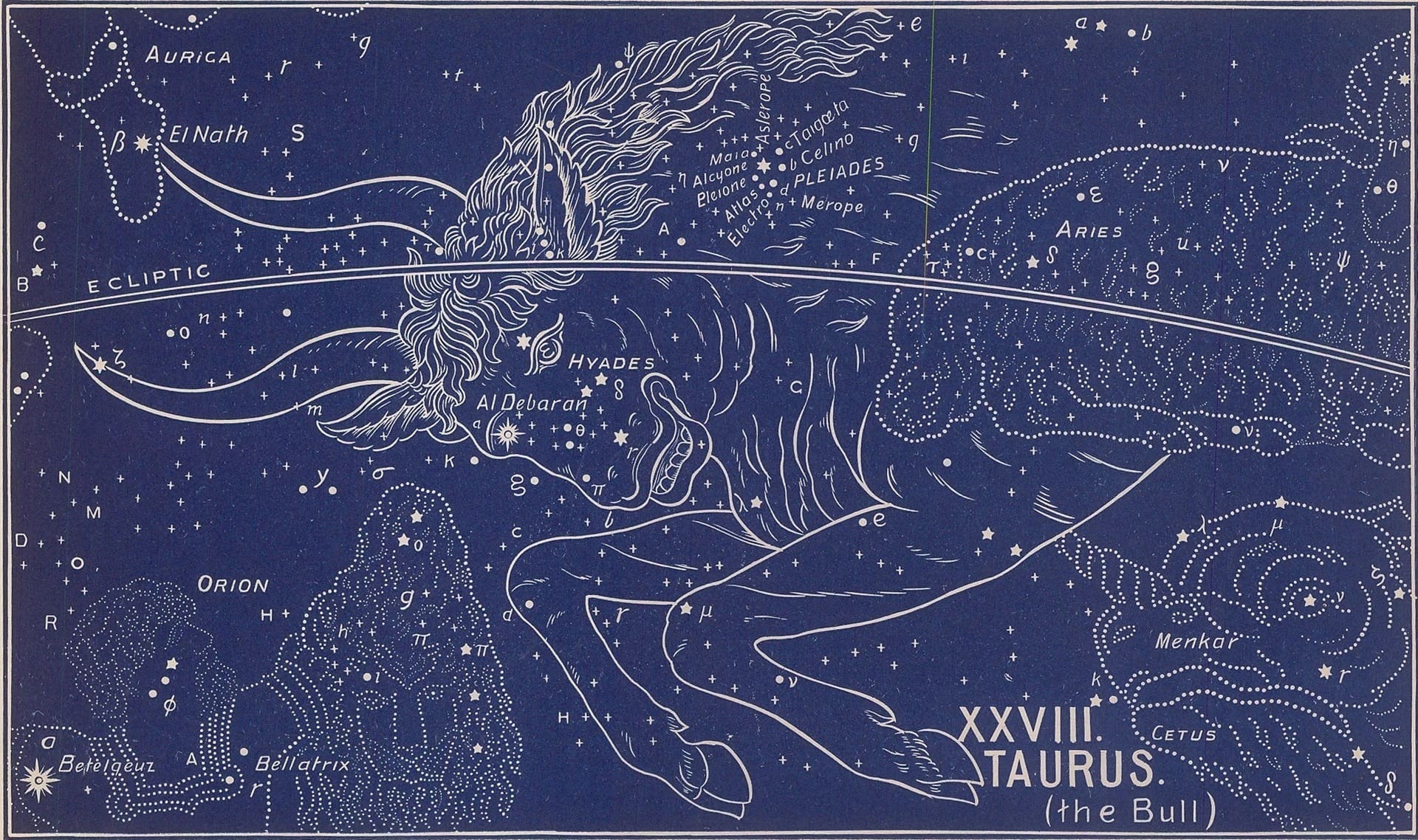
Taurus Constellation [Bullinger]
Bullinger (1893)
The Sign TAURUS (The Bull).
The picture is that of a Bull rushing forward with mighty energy and fierce wrath, his horns set so as to push his enemies, and pierce them through and destroy them. It is a prophecy of Christ, the coming Judge, and Ruler, and “Lord of all the earth.” The Egyptian Zodiac of Denderah already, 4,000 years ago, had forgotten the truth to which the prophecy had referred, and called him Isis, i.e., who saves or delivers, and Apis, i.e., the head or chief. The Bull is clearly represented, and in all the zodiacs which have come down to us is always in the act of pushing, or rushing.
The name of the sign in Chaldee is Tor. Hence, Arabic, Al Thaur; Greek, Tauros; Latin, Taurus, etc. The more common Hebrew name was Shur, which is from a root which means both coming and ruling. There are several Hebrew words for bulls and oxen, etc. But the common poetical term for all is Reem, conveying the idea of loftiness, exaltation, power, and pre-eminence. We find the root in other kindred languages (Etruscan, Sanscrit, etc.), and it can be traced in the name of Abram, which means pre-eminent or high father; Ramah, high place, etc.
The stars in Taurus present a brilliant sight. There are at least 141 stars, besides two important groups of stars, which both form integral parts of the sign. [18]
Robson (1923)
TAURUS. The Bull.
Legend. Jupiter, assuming the form of a bull, mingled with the herd when Europa, with whom he was infatuated, and her maidens disported themselves on the sea-shore. Encouraged by the tameness of the bull Europa mounted it, whereupon the God rushed into the sea and bore her away to Crete. According to other accounts Taurus represents Io whom Jupiter turned into a cow in order to deceive his wife Juno.
Influence. Ptolemy makes the following observations: “Those stars in Taurus which are in the abscission of the sign resemble in their temperament the influence of Venus, and in some degree that of Saturn . . . the stars in the head (except Aldebaran) resemble Saturn, and, partly, Mercury; and those at the top of the horns are like Mars.” By the Kabalists Taurus is associated with the Hebrew letter Aleph and the 1st Tarot Trump “The Juggler.” In all the ancient Zodiacs, Taurus is the beginning sign and marked the Vernal Equinox from about 4,000 to 1,700 B.C. [19]
Rigor (1979)
TAURUS: Symbolized by the Bull.
Taurus is derived from Egyptian or Coptic root meaning bull or cow.
MYTHOLOGY: In the 12 tribes of Israel the sign, Taurus, signifies Reuben. “Reuben, thou art my strength, the excellence of power.” (Genesis 49)
Juno one day saw that it suddenly grew dark and suspected that her husband had raised a cloud to hide some of his doings. She brushed away the cloud and saw her husband on the banks of a glassy river with a beautiful heifer standing near him. She suspected that the heifers form concealed some fair nymph, which turned out to be the case. It was Io, the daughter of the river god, Inachus, to whom Jupiter had been making love; and when she became aware of his wife spying on him, she changed herself into the form of a heifer.
Taurus, a fixed sign, denotes the soul qualities. And Io wearing the outer form of the heifer, represented the soul or the evolving Ego.
Cadmus was told to follow a lone cow, one who had left the herd. The cow symbolizes one who strives for individuality and ceases to be one of the crowd depending upon a leader for those who seek true wisdom must seek within themselves, often foregoing the many social enjoyments and pleasures of this material existence.
TAURUS endows the individual with great determination and fixity of purpose and once having decided upon a course of action, it is almost impossible for them to change their minds. On the other hand, Taureans respond very quickly to kindness or an appeal to the finer side of nature. Generally, Taureans are fond of pleasure and pursuits of these objects. Generally good earning capabilities signify the Taurean, also a love of music and of art. Gain may be derived through efforts that require more mental than physical situations. Taureans at times lack continuity and, therefore, may make changes throughout their life. Such natives have an enterprising mind and capabilities that require action. Moderation should be observed by Taureans and they should avoid being drawn into affairs which their better judgement cautions them against.
Negatively; Taureans can be very stubborn, completely unreasonable. They can be obstinate and entirely too materialistic and possessive, be it material things or persons. They can be very untrusting and suspicious, forgiving but never forgetting a wrong, fancied or real, sometimes they can be slovenly and over-indulgent, overly conservative and anti-progressive.
KEYWORDS for the Taurus constellation:
(+) Positive: Dominant, independent, ambitious, persevering, artistic appreciation, dependable, adaptable, intuitive, self reliant, patient, a tireless worker, determined, self reliant, patient.
(–) Negative: Brutishly stubborn, possessive, overly materialistic, untrusting, overly indulgent, indifferent, domineering, jealous, obstinate, emnity.
SUN IN TAURUS (+) Endows its natives with self-reliance, persistence, determination, practicality, a cautions nature, persistence, one who is dignified and democratic in expression, a steadfast person, strong endurance powers, one who is courageous, discriminating, practical, accumulates and is acquisitive, has powerful instincts, can be self-willed, seeks security.
SUN IN TAURUS (–) Possessiveness, self-gratification, inflexible, extravagance, greedy, stubborn, resentful, overly cautious, boring.
MOON IN TAURUS (+) Endows its natives with an agreeable disposition, determination, conservativeness, an ambitious nature, steady emotions, one who is persistent, self-reliant, appreciative of art and finer things in life. A love of traveling, a gentle disposition, one who is loyal, practical and serene. A reliable person, sociable.
MOON IN TAURUS (–) The native may become very stubborn, too conservative, sensual and fun-loving. Native is overly possessive. One who is smug, conceited and has a grasping nature. A jealous person. One who is possessive.
MERCURY IN TAURUS (+) Endows its natives with an appreciation of artistic matters, one who is thorough and has a persistent mentality, one with steadfast emotions, tempered with reason, a rententive and an alert memory, alert for pleasure and business. One who is a pleasing companion, has a fondness for the opposite sex, a desire and the ability to accumulate possessions, the ability to keep counsel.
MERCURY IN TAURUS (–) An inflexible outlook, one who is obstinate, secretive and avaricious. Slow in making decisions. May become reclusive and harbor secret resentments.
VENUS IN TAURUS (+) Endows its natives with a solid, lasting emotional relationship. One who remains affectionate. A person with decided opinions, a graceful and artistic nature. An attractive and acquisitive nature. One who appreciates artistic matters. A person with deep feelings, not always openly expressed. Tenacious in their opinions. A likable companion.
VENUS IN TAURUS (–) The native may become tenacious, fixed in their opinions. May develop greed and become of a grasping nature. The native is liable to over-extend themselves, be inconsiderate of friends, relatives, one who is inconstant in their affections. Subject to extreme emotional relationships, very possessive.
MARS IN TAURUS (+) Endows its natives with the strength of an unconquerable character, a persistent and a steadfast quality. Native acknowledges no defeat, gains their objectives through stubborn determination. One who is a steadfast worker with patient energy, who is enterprising but practical, one who is loyal, patient, but firm and has a powerful combination of firmness and energy properly directed. Native has a tendency to acquire economical independence.
MARS IN TAURUS (–) Native is extremely possessive, stubborn, very clever and tricky. May be very unreasonable, of an unforgiving nature, even vindictive. Subject to unpleasant outbursts. A sensuous person. One who is destructive and disloyal. [20]
Noonan (1984)
Taurus marked the vernal equinox from about 400 B.C. to 1700 B.C. In all ancient zodiacs preserved to us it began the year. Its part of mankind includes procurers, those who like to eat, drink, and make merry, and “all those longing for coition.” The sign is indicative of those who are eager for marriage, and like Aries is also correlative of small families. The first part (decanate) of Taurus is even considered to indicate sterility. On the whole the Classicists considered Taurus an unfortunate sign, although a manuscript almanac of 1386 had: “Whoso is born under yat synbe schal have a grace of bestis”; and thunder, when the sun was in Taurus, “brought a plentiful supply of victuals.”
In physical characteristics the Taurean native will be tall with a broad forehead and black downcast eyes with small whites. Their nose will be broad with the point upturned. They will have a large mouth, thick lips, black hair, and a strong neck. The modern astrologers add that he is unusually heavy, and that his movements are apt to be deliberate,
In personality this sign is indicative of those who are very lustful and gluttonous, and have a habit of contraries. They will exercise good judgment, but will have a tendency toward negligence. Those born in the first decanate will be noble at heart, will enjoy all kinds of delight, and will have numerous friends; in the second decanate the native will have a generous soul and will be intelligent; in the third decanate the native will have no luck in their dealings with the opposite sex.
Modern astrologers attribute the following characteristics to Taurus: patient, jealous, obstinate, affectionate, indifferent, and sometimes hot-tempered.
As to the professions the Classicists mention sellers, tailors, weighers of grain, fishermen, cobblers, agents, and farmers. The Modernists add art dealers, financiers, and singers. [21]
Noonan (1990)
The Constellation of the Bull
This constellation was an object of worship by primitive cultures through the ages. To the ancient Egyptians it was the bull-god Orissi, but according to R. A. Allen in Star Names and Their Meanings, the constellation was also worshipped by the Babylonians, Chinese, Druids, and some tribes of Amazon Indians. Its stars, according to Tetraiblos are:
“…like Venus along the line where the constellation is cutt off [Taurus is represented as the head and fore-part only of a charging bull. These stars are 5-Tau. 4-Tau. 3-Tau, 0-Tau, and 30-Tau.]; those in the Pleiades have the nature of the Moon and Jupiter; the one in the Hyades that is the brightest and somewhat reddish called the Troch (Aldebaran) has a ‘temperature’ like that of Mars; the others (in the hyades) like that of Saturn and moderately like that of Mercury, and those (stars) in the tips of the horns, like that of Mars.”
The Bull is now called Taurus (Tau) and traditionally presages the results of the beginnings of large political undertakings. The constellation also portends that which affects wild animals, especially those of danger to man. [22]
In mundane astrology, the Bull presages the results of the beginnings of large political undertakings, proclamations, the start and end of wars, battles, invasions, sieges, and large constructions, statues, and monuments.
References
- A Dictionary of Modern Star Names, Kunitzch, Smart, 2006, pp. 54-55.
- Taurus in Chinese Astronomy.
- Star Names: Their Lore and Meaning, Richard H. Allen, 1889, pp. 378-413.
- Constellations: Taurus ‘the Bull’, h2g2.com
- Theta Tauri – Wikipedia.
- Kappa Tauri – Wikipedia.
- Lambda Tauri – Wikipedia (French).
- Lambda Tauri – Wikipedia (English).
- Reddit- Dravidiology.
- Nu Tauri – Wikipedia.
- Xi Tauri, en-academic.com
- Omicron Tauri, fr-academic.com
- 5 Taurus – Wikipedia
- Astronomica, Manilius, 1st century AD, Book 4, X, p.10, 25. (Creech, 1700).
- Astronomica, Manilius, 1st century AD, book 4, p.233, 263. (Goold, 1977).
- Tetrabiblos, Ptolemy, 2nd century AD, Book 1, Chapter 9.
- Mathesis, Firmicus Maternus. @335 AD, Book 5, pp.5-6, 29-30, 50-51.
- The Witness of the Stars, E. W. Bullinger, 1893, 28. Taurus (the Bull).
- Fixed Stars and Constellations in Astrology, Vivian E. Robson, 1923, pp. 62-63.
- The Power of the Fixed Stars, Joseph E. Rigor, 1979, pp. 59-60, 315-316, 321, 325, 330, 334-335.
- Classical Scientific Astrology, George Noonan, 1984, pp. 66-68.
- Fixed Stars and Judicial Astrology, George Noonan, 1990, pp. 33-35.